
1. Why wooden beads from 1 year?
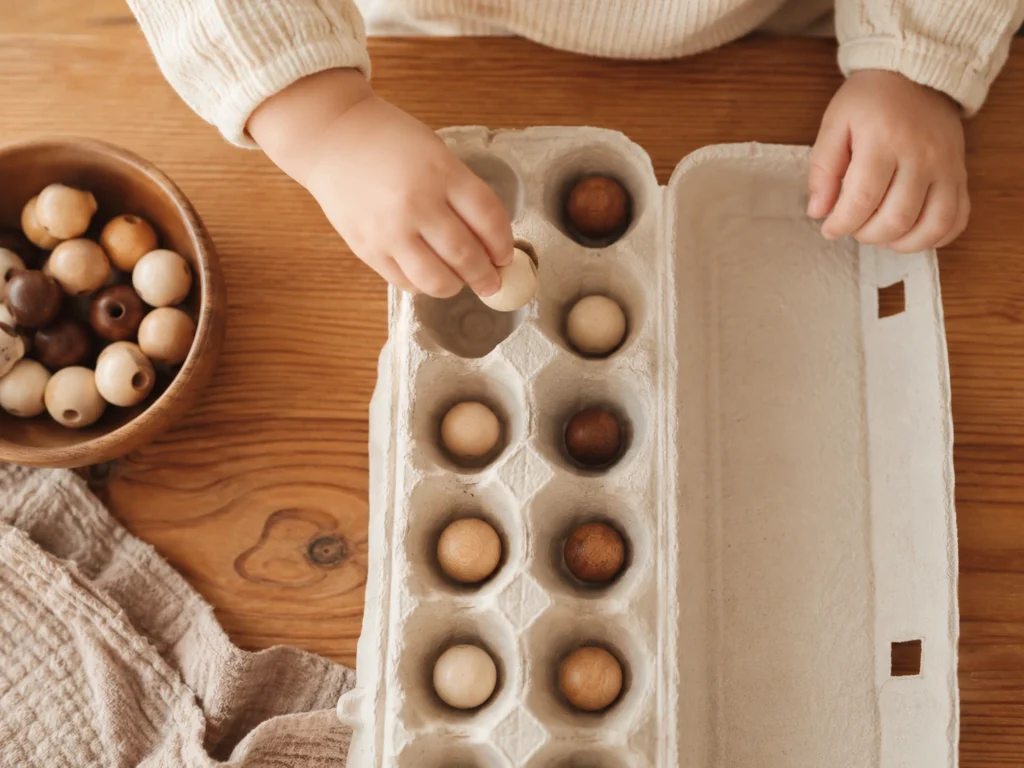
Around twelve months old, the pincer grip is developing, deliberate release is mastered – and most importantly: the child wants to act. They grasp, push, tap, sort. Wooden beads fit perfectly into this developmental stage, because they are:
- Big enough for still-clumsy hands – if you choose beads from 20 mm up.
- Heavy enough to give a sense of grasping success – the hand feels: I’ve got hold of something.
- Clear in form, without distracting noises or lights.
- Versatile: A bowl of wooden beads is enough for countless play ideas.
2. Safety first
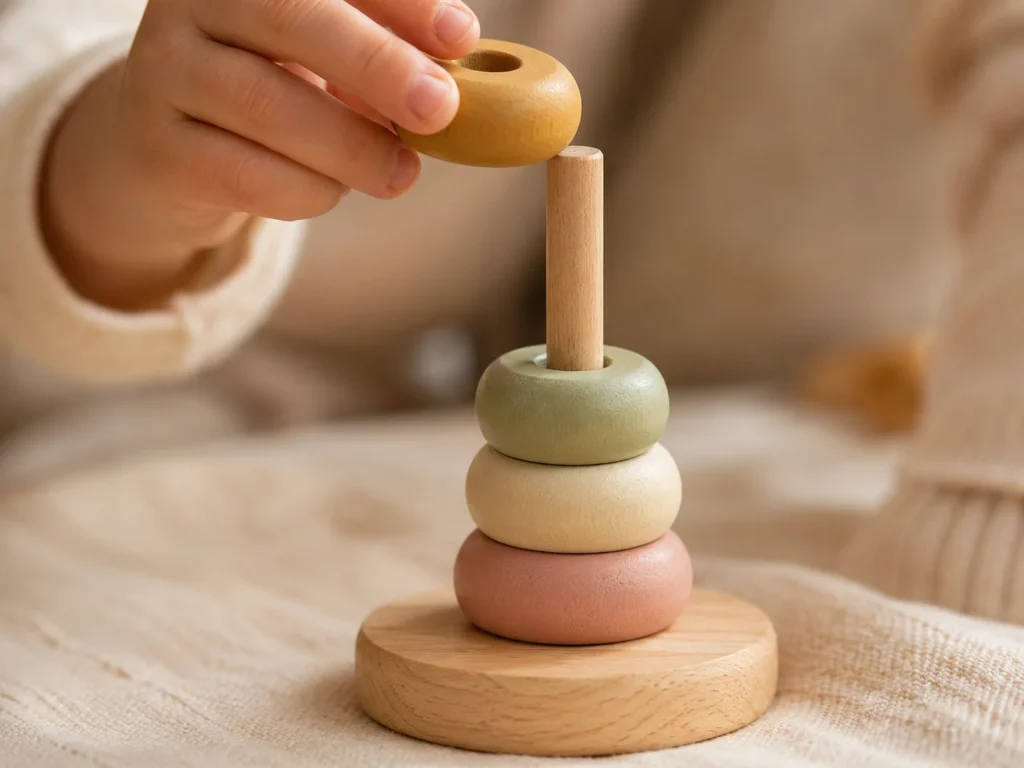
An important note first: children under three primarily explore materials with their mouth. That’s normal, not wrong. Your responsibility is to make sure the exploration is safe. These rules are non-negotiable:
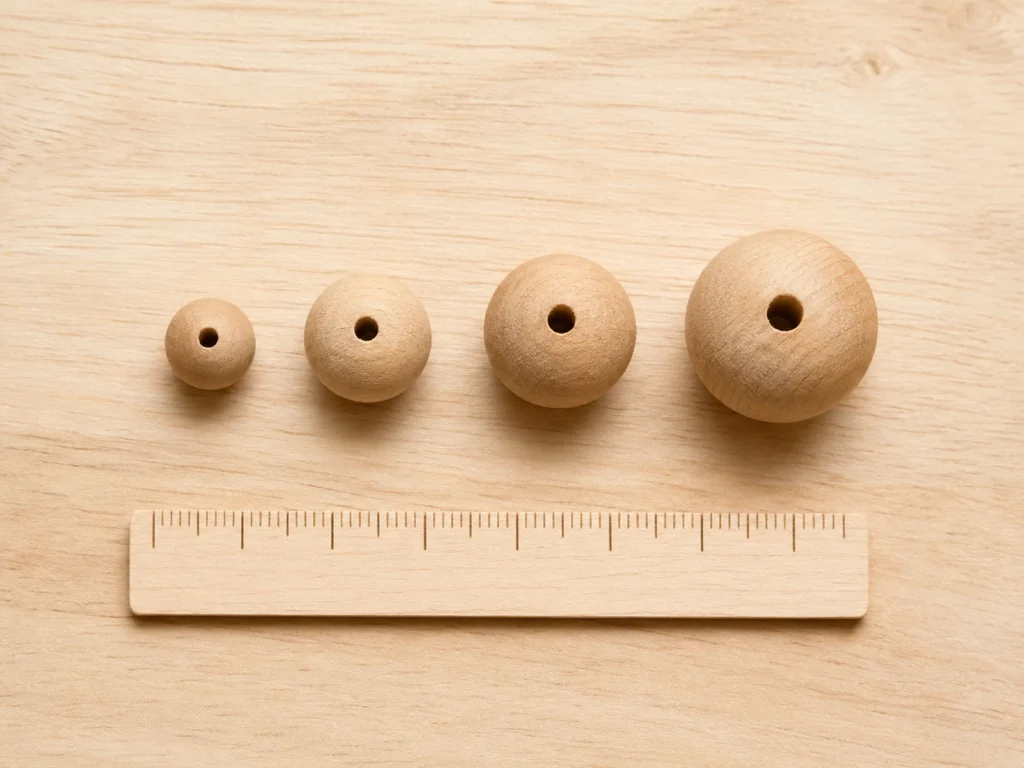
- Minimum size 20 mm – Beads smaller than 32 mm are theoretically swallowable. At 20 mm and larger (ideally from 25 mm) and under supervision, the risk is manageable.
- Only EN 71-3 tested wooden beads. Saliva-proof, free from harmful substances, colourfast – see Safe craft materials.
- Never unsupervised with children under 3 years.
- Check regularly for damage – remove any cracks, splintered edges or worn drill holes.
3. Which size from which age?
| Age | Recommended bead size | Setting |
|---|---|---|
| 1–18 months | from 30 mm diameter | Direct supervision only |
| 18 months – 2 years | from 25 mm | Under supervision, no knots |
| 2–3 years | from 20 mm | Under supervision |
| 3–4 years | from 15 mm | Independent play possible |
| 4+ years | from 10 mm | Freely accessible |
4. Fifteen tried-and-tested play ideas – by developmental stage
First exploration (12–15 months)
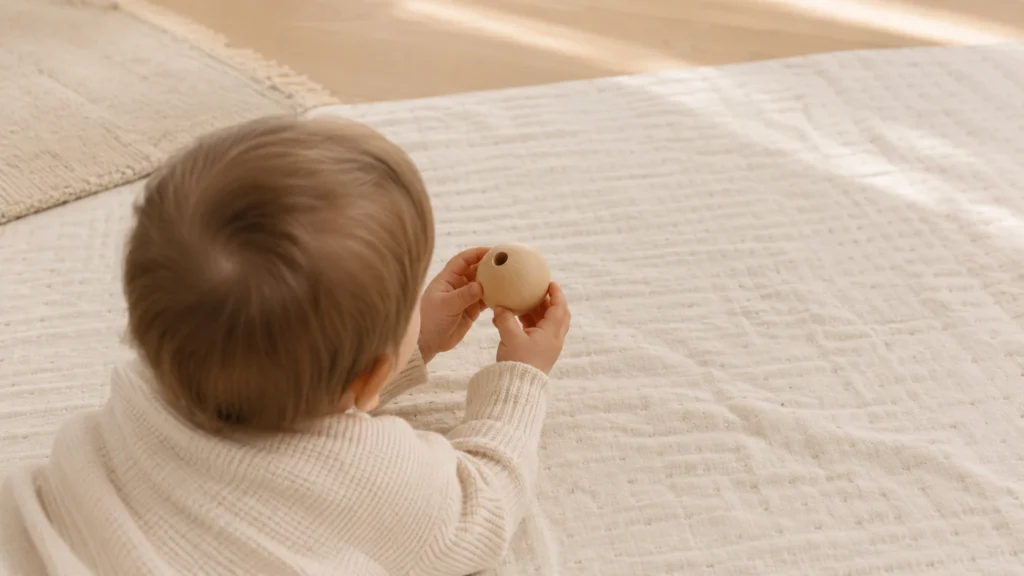
- Wooden bead in hand: Offer a single large wooden bead – the child takes it, turns it, drops it. Repetition over weeks.
- Wooden bead in a bowl: A bowl with 5–6 beads and an empty bowl next to it. Transfer beads by hand.
- Bead from the box: Shoebox with hole in the lid. Drop beads in and shake – the child hears they’re still there.
Grasping & releasing (15–18 months)
- Fill an egg box: Large egg box with ten compartments. Place one bead in each compartment.
- Wooden bead in a bottle: Small wooden bead (safely 30 mm) into an empty plastic bottle. Great effect with the sound.
- Stack beads in beakers: Three beakers of different sizes – place beads in each beaker.
Sorting & matching (18 months – 2 years)
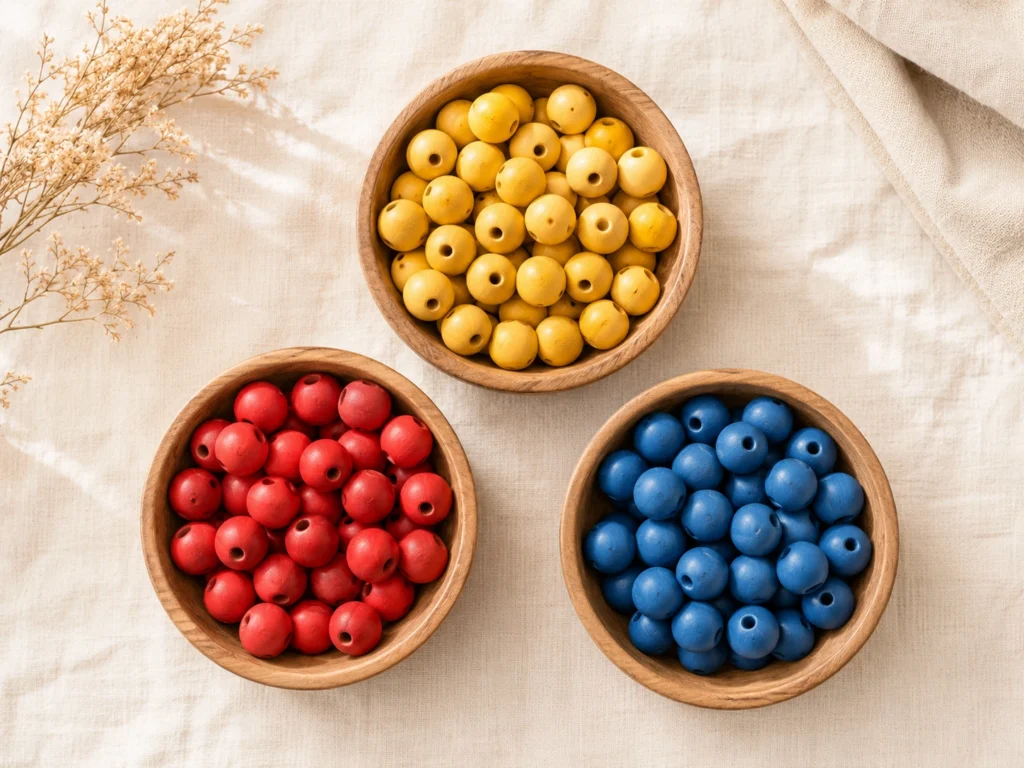
- Colour sorting: Two bowls, beads in two colours. Show first, then let them try.
- Size sorting: Small and large beads into different bowls.
- Bead box: Box with different compartments – each colour gets its own space.
Threading & building (2–3 years)
- Threading onto wooden stick: Wooden beads with large holes onto a wooden dowel – easier than string.
- Threading onto firm string: First firm cord (stands by itself), later flexible string.
- Wooden bead rows: Arrange beads in lines on the table – copy patterns.
Role play & storytelling (from 2.5 years)
- Beads as “food”: Wooden beads in the play kitchen – cake decoration.
- Beads as “treasure”: Hide and find in the sandpit or a bowl.
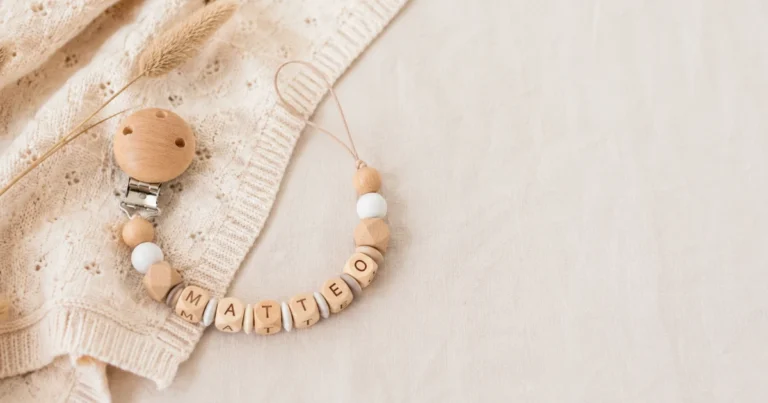
- Beads for the birthday table: Birthday child receives a hand-threaded string with the letters of their name (see Letter beads).
5. Wooden bead rituals for everyday life
Materials have most impact when they become part of a routine. Three small rituals that fit into everyday life with toddlers:
- Morning bead: While getting dressed, the child chooses a bead from a bowl and places it on the table – start-of-day ritual.
- Helper on the changing table: A wooden bead in the child’s hand while on the changing mat – calming and focusing.
- Evening gather: Before bedtime, all day’s beads go back in the bowl – end-of-day ritual.
FAQ
How many wooden beads do I need for a toddler?
At home, 20–30 beads in two or three sizes are enough, plus 10–15 letter beads from age 3. For a nursery group, much more – 100–200 in different colours.
What if the child swallows the wooden beads?
Beads from 25 mm diameter are not swallowable (small parts cylinder test). Still: only supervised play, and in any doubt, call emergency services immediately.
How do I clean wooden beads?
A damp cloth is usually enough. For heavier dirt, rinse briefly under running water, then dry thoroughly (otherwise the wood swells).
What if the child keeps throwing the beads away?
That’s a phase – deliberate throwing is a developmental milestone. Respond calmly and don’t always pick the bead up yourself. Often the game helps: “Where’s the bead?” – search together.
Wooden bead sets for nurseries and childminders: Large quantities in nursery sizes, EN 71-3 tested, volume discount from 10 units, delivery on account with 14 days payment terms. Enquire for your setting.
Craft ideas with wooden beads for baby gifts can be found in our Craft sets – from teething rings to dummy chains.