
1. The Principle: A Prepared Environment Rather Than Lots of Toys
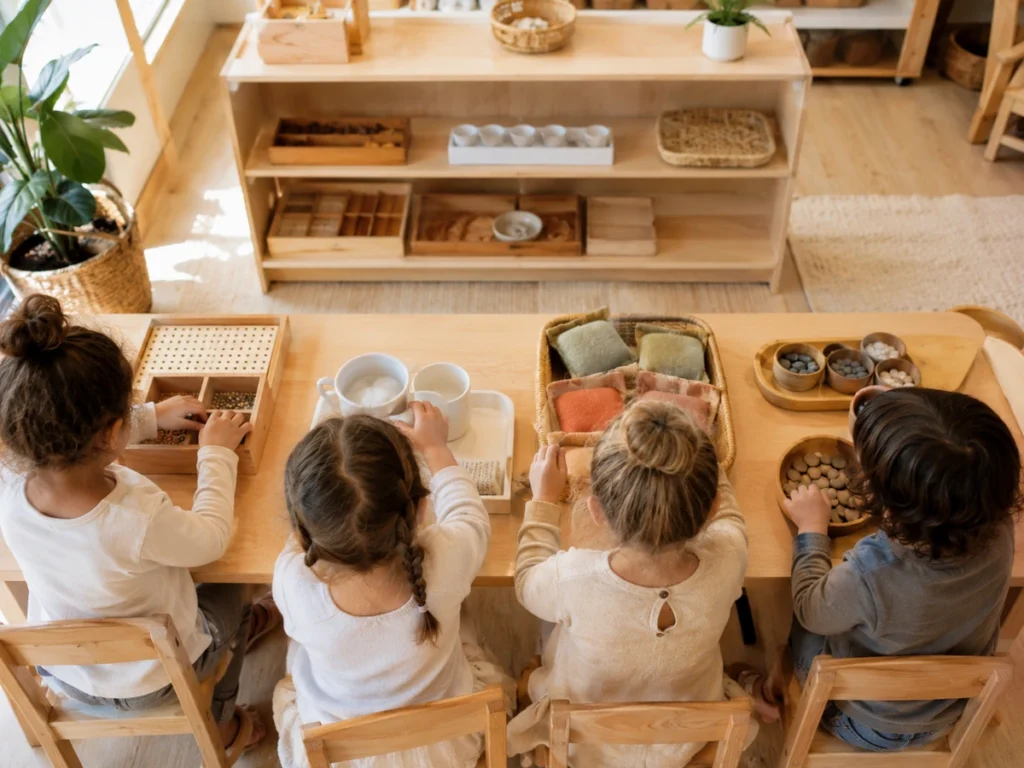
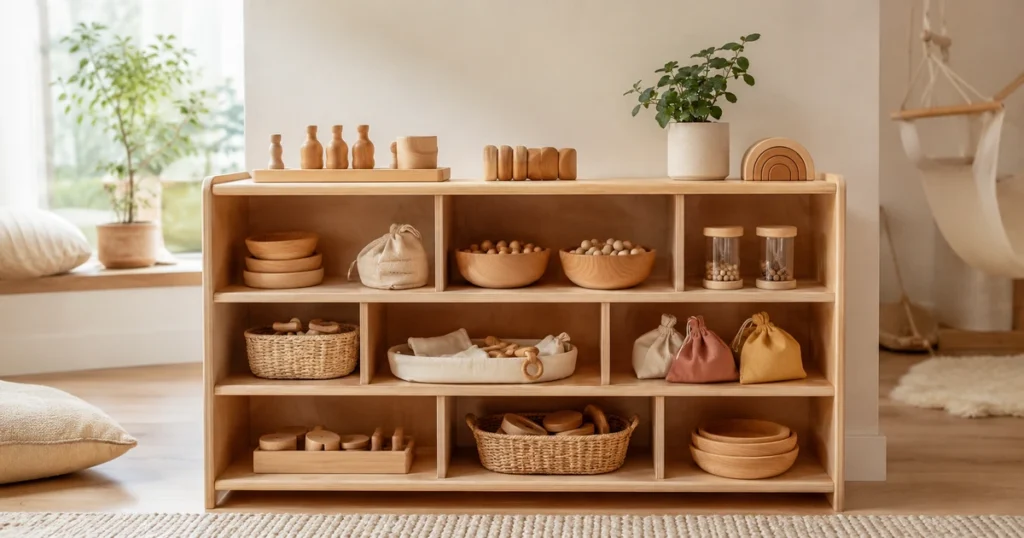
Montessori education isn’t primarily about materials — it’s about approach. At its heart is the prepared environment: the room, furniture and materials are all designed so that children can act independently. This has real, practical consequences for nursery provision:
- Materials sit on open shelves at child height, not locked away in cupboards.
- Every material has its own place — a hint of order that two- and three-year-olds can navigate.
- The choice is intentional: twenty thoughtful materials beat a hundred random toys.
- Every material is complete and in working order. A threading board with a missing string becomes a source of frustration.
In practice, this means: when buying for your group, it’s worth buying less — but more purposefully. It’s kinder to your budget and your precious shelf space.
2. The Five Categories of Montessori Material
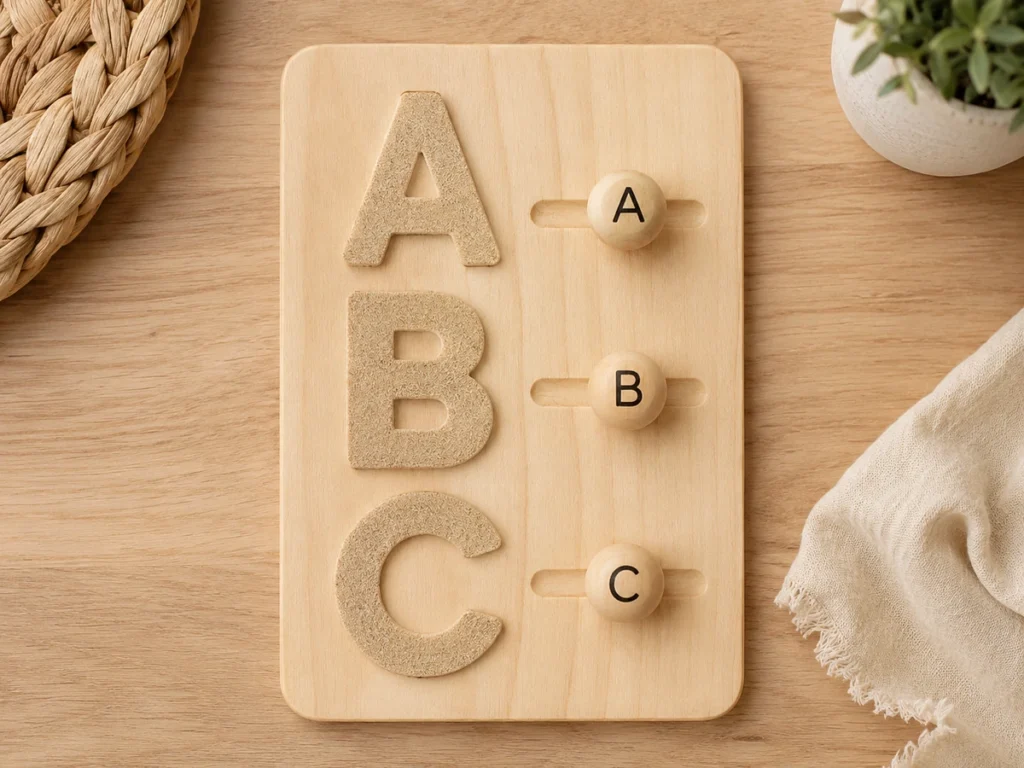
Maria Montessori distinguished five main categories. In nurseries and preschools, the first three are used most:
| Category | What it Develops | Examples from Everyday Nursery Life |
|---|---|---|
| Practical Life Activities | Independence, fine motor control, concentration | Pouring, spooning, fastening buttons, tying bows |
| Sensorial Materials | Refining perception, building concepts | Touch bags, sound bottles, colour tablets |
| Mathematics Materials | Understanding quantity and number | Red rods, spindle box, bead materials |
| Language Materials | Vocabulary, letters, writing | Sandpaper letters, word cards, letter beads |
| Cosmic Education | Understanding the world — nature, geography, biology | Life cycle cards, globes, animal figures |
3. Materials for Under-Threes: What 1- to 3-Year-Olds Really Need
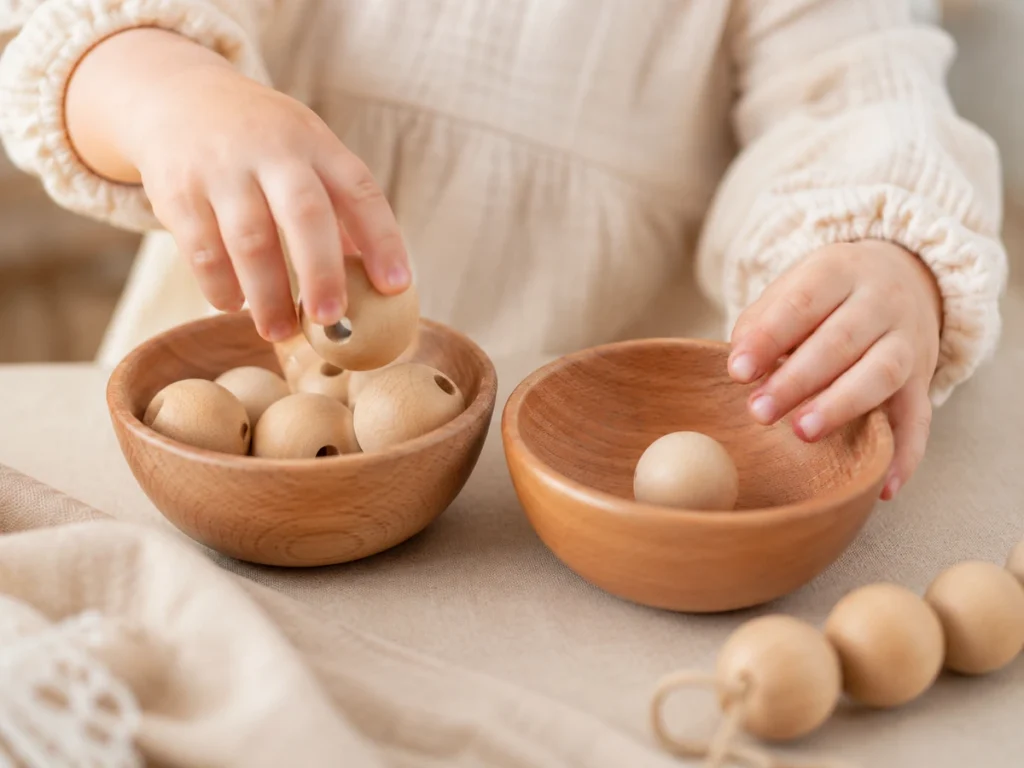
In the nursery for under-threes, it’s not about the classic spindle box or pink tower. The youngest children need materials that support their developing movement and grasping skills. What works really well in practice:
- Wooden rings and grasping toys in different sizes — they develop the pincer grip and controlled releasing.
- Pouring and transferring sets made from glass or ceramic (child-safe, smaller items). Transferring beans, rice or large wooden beads — one of the most absorbing activities you can offer.
- Wooden stacking tower with graduated sizes — develops hand-eye coordination and introduces the concept of size.
- Touch bags filled with natural materials: chestnuts, pine cones, felt balls, smooth pebbles. Children explore by touch, describe what they find, and sort them.
- Sorting boards with large wooden beads in two or three colours — an introduction to sorting and classification.
Important for under-threes: all small items must be tested to DIN EN 71-3 standards. Wooden beads under 30 mm should never be left unsupervised in a group of under-threes. More on this under Safe Craft Materials.
4. Materials for Preschool: Supporting Three- to Six-Year-Olds Systematically
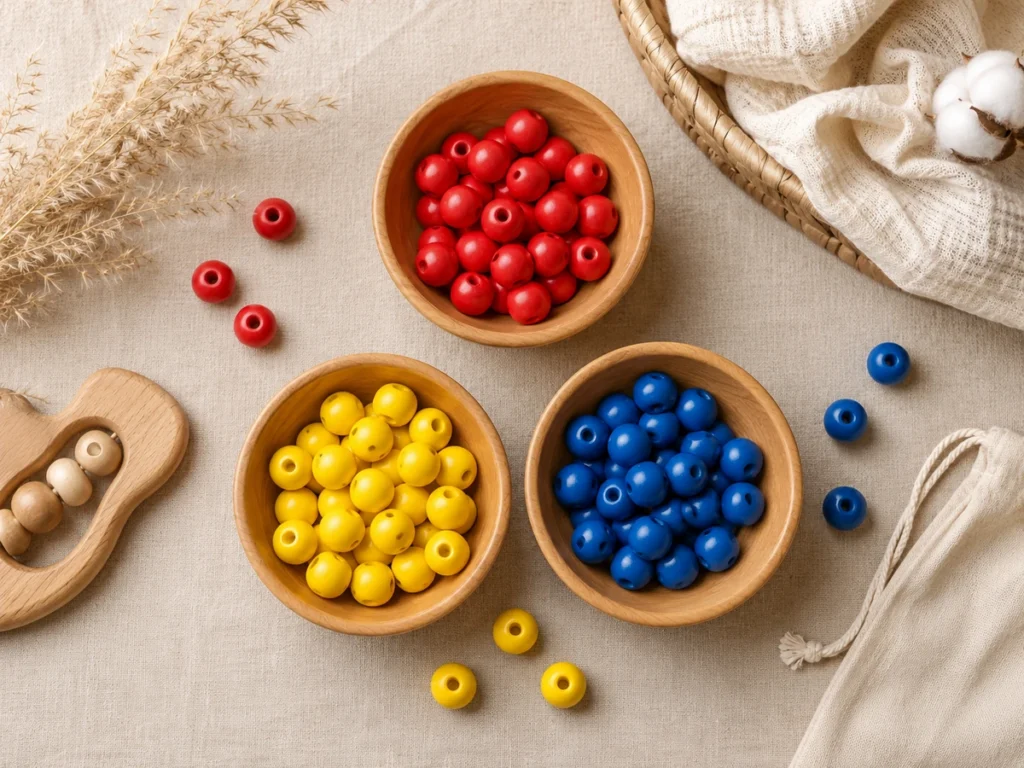
From age three onwards, the range of materials expands considerably. Now the classic sensorial and mathematics materials come into their own:
- Spindle boxes and number cards to build understanding of quantity from 0 to 10.
- Bead materials as a bridge between concrete and abstract number. A single golden bead represents 1, a ten-bar represents 10 — making quantity genuinely tangible.
- Sandpaper letters: tracing them with your finger embeds the letter shape twice over — through sight and touch.
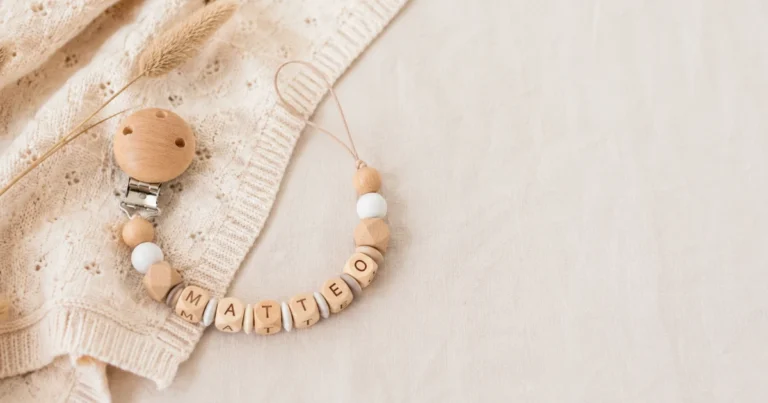
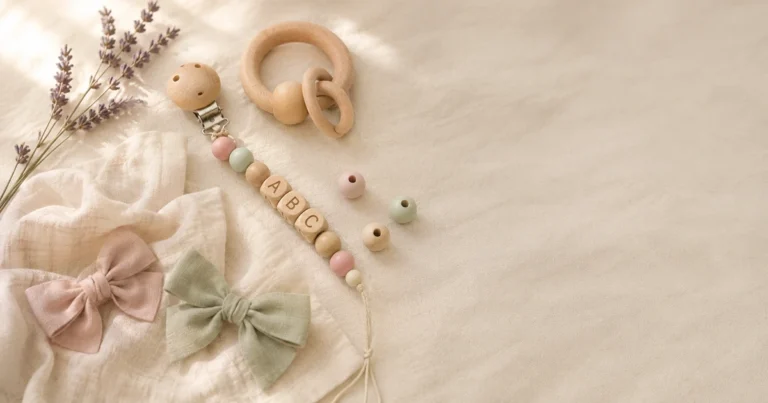
- Wooden letter beads for forming words and threading your own name — a bridge between language work and fine motor skill development.
- Sound bottles in matching pairs — children have to find the pairs from memory, which powerfully develops their listening skills.
5. What to Look for When Buying — The Five Essential Criteria
- Natural materials over plastic. Wood, fabric, metal, glass — these materials engage the senses more fully and age beautifully. Plastic feels sterile and offers no tactile richness.
- Clear purpose, no ‘toy effect’. Genuine Montessori materials aren’t distracting with sounds, lights or characters. They focus on a single learning goal.
- Self-correction built in. Good material tells the child whether they’ve succeeded — the wooden bead fits into exactly one slot, for instance.
- Safety certification. EN 71-3 compliance, no toxic paints, saliva-resistant colours — standard for anything going into an under-threes group.
- Repair and replacement options. Check that you can buy individual pieces (like beads) if something goes missing.
In our Eduplay range you’ll find a curated selection of Montessori-suitable materials — from wooden beads to complete learning sets.
FAQ: The Most Common Questions from Real Nurseries
Do Montessori materials have to be ‘authentic’ to work?
No. The method isn’t trademarked. What matters is that the material follows the principles: clarity, self-correction, sensorial focus. An affordable wooden bead set that meets these criteria can be just as valuable educationally as an expensive branded set.
How many materials should a group have?
As a rule of thumb: 15–25 materials per age group on open shelves, rotated monthly. Better to have fewer materials readily accessible than a bursting cupboard.
Can I make Montessori materials myself?
Yes — you can make many materials from wooden beads, fabric scraps and natural materials. What’s crucial is safety: components must be tested to EN 71-3 standards.
Special rates for nurseries: We supply Eduplay and Montessori materials on invoice with 14 days’ payment terms to nurseries and educational establishments. Quantity discount from 10 items, free delivery on orders over €100. Submit your nursery enquiry now.