
1. Common Bead Hole Standards
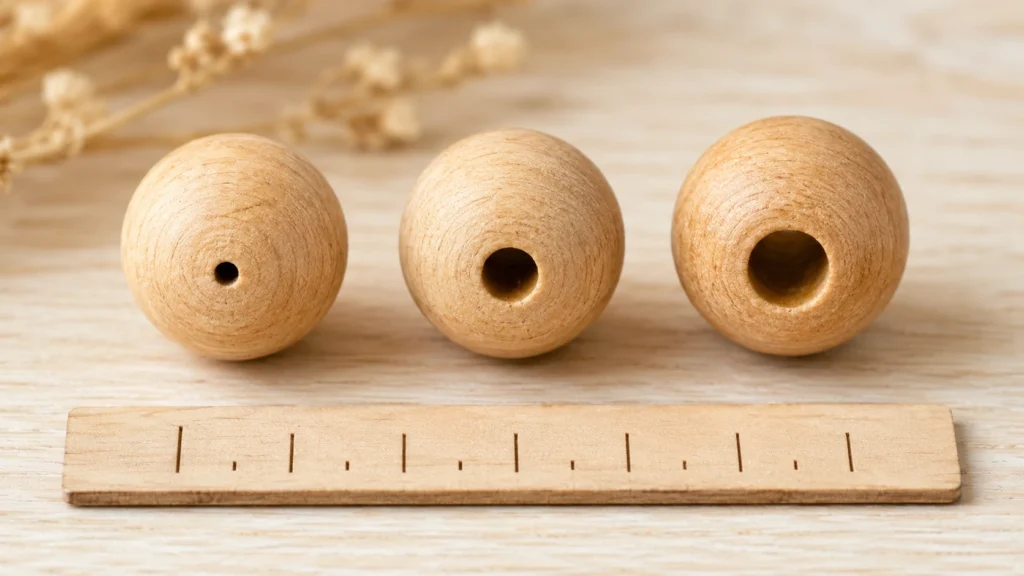
Most wooden beads in the German craft materials market follow three standard hole diameters:
- 2 millimetres — the absolute classic. This hole suits the most common polyester, satin and cotton cords with a 1 to 1.5 mm diameter. For dummy chains, it’s the most popular choice because it’s tight enough that the bead won’t slip past the knot, yet wide enough that the cord slides easily through.
- 3 millimetres — the middle ground. Ideal for thicker cords (2 to 2.5 mm), such as elastic bands for pram chains or double-threaded cords. Also often used for crochet bead combinations.
- 4 millimetres — the large hole. Mainly for wooden beads where a leather strap, plaited cord or multiple cords need to thread through at once. With classic dummy chains, it’s quite rare, but more common in rattles with split rings.
Beyond these, there are specialist sizes — for example, fine wooden lentil beads with a 1.5 mm hole for very delicate craft work, or wooden spheres with a 6 mm hole for thick rope cords. We stock the three standard sizes across our range because they cover about 95 per cent of all craft projects.
2. Which Cord Suits Which Hole Size?
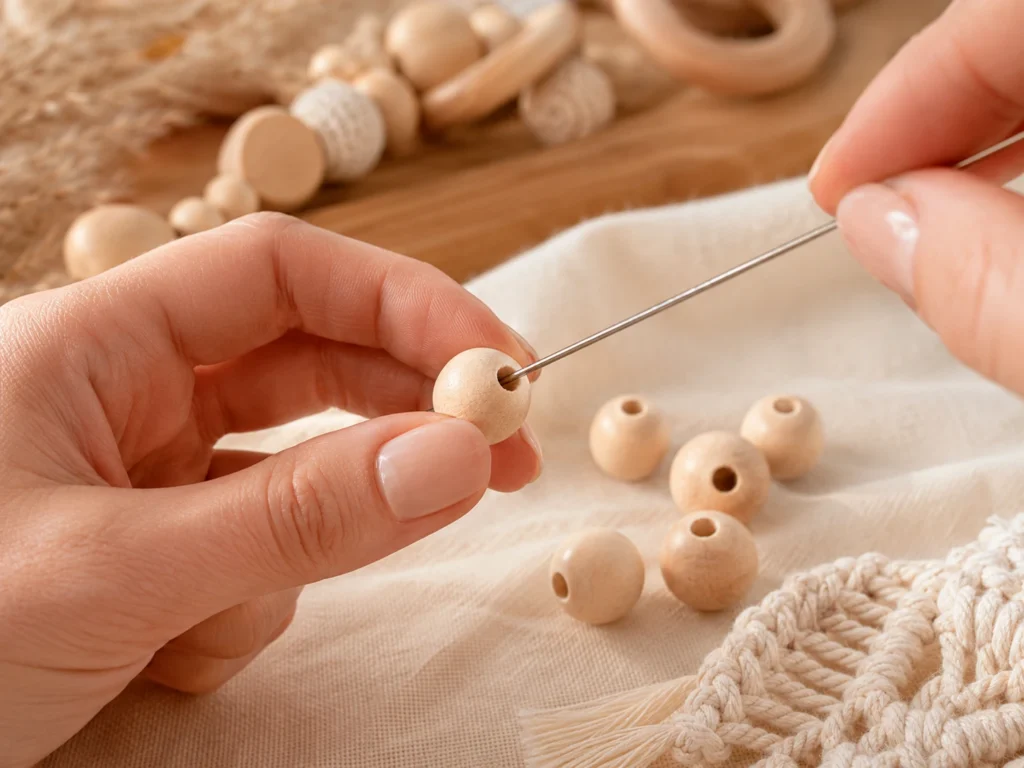
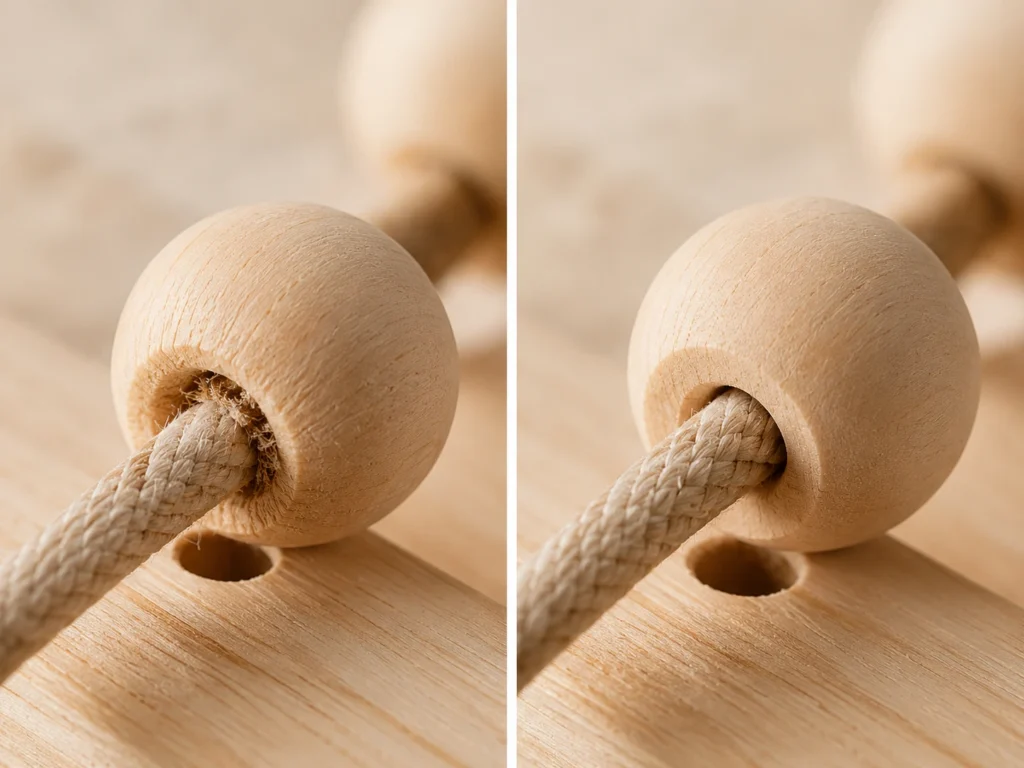
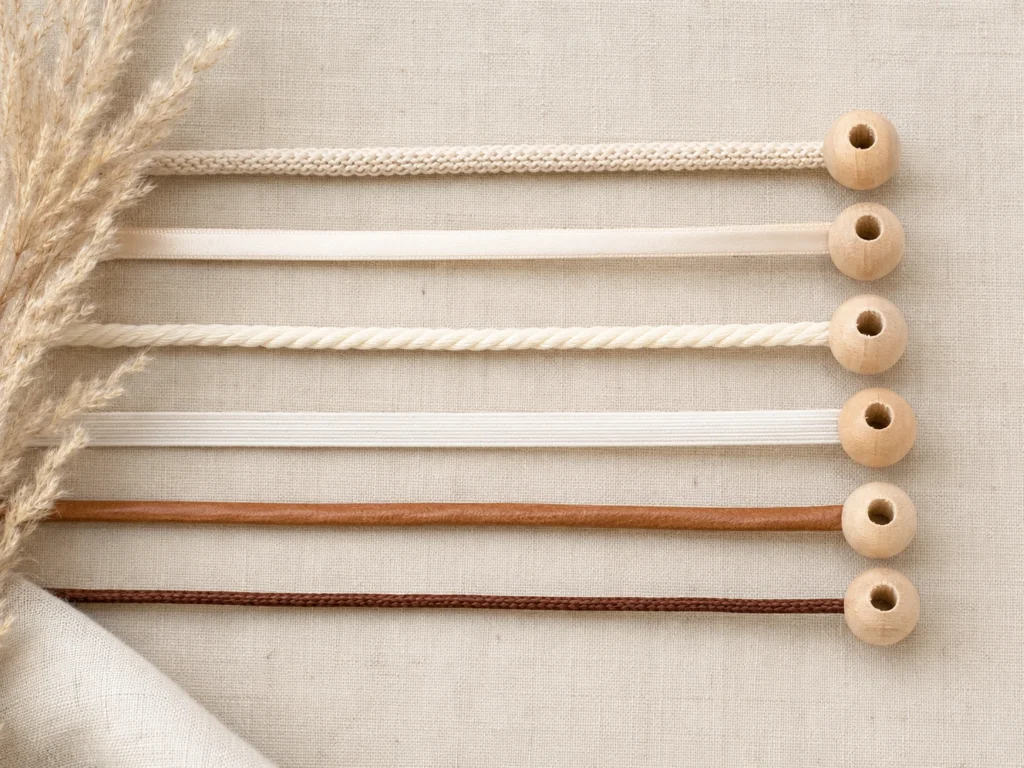
The rule of thumb is: the hole should be about 0.5 to 1 millimetre larger than the cord diameter. That way the cord passes through smoothly but not too loosely. Here’s a handy reference:
| Cord Type | Cord Diameter | Recommended Hole |
|---|---|---|
| Fine polyester cord | 1.0 mm | 2 mm |
| Standard polyester cord | 1.2 mm | 2 mm |
| Satin ribbon 1 mm | 1.0 mm | 2 mm |
| Satin ribbon 1.5 mm | 1.5 mm | 2–3 mm |
| Fine cotton cord | 1.5 mm | 2–3 mm |
| Sturdy cotton cord | 2.0 mm | 3 mm |
| Elastic band for pram chains | 1.5–2.5 mm | 3 mm |
| Narrow leather strap | 2.5–3 mm | 4 mm |
We cover the comparison between polyester cord and cotton cord in detail in our article Polyester Cord vs. Cotton Cord.
3. Safety Beads — the Special Case
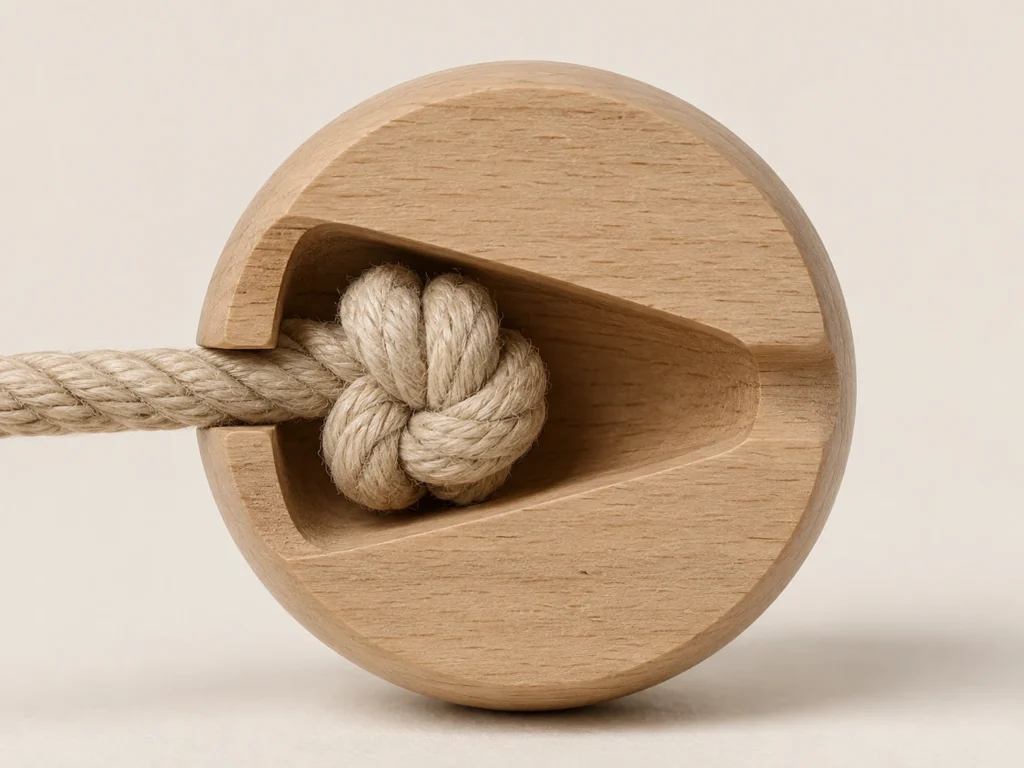
Safety beads aren’t a decorative element, they’re a technical component. They sit at the start and end of the dummy chain and make sure the cord’s knot “disappears” — in other words, isn’t visible or reachable from the outside. This stops the knot coming undone under strain.
A classic safety bead has a conical hole that tapers from outside to in. On the outside, the hole is roughly 2 millimetres wide — right for standard cord. Inside the bead is a small indent where the double knot grips tightly. When you pull from the outside, the knot presses against the narrowing and can’t slip.
The design rule: always use a safety bead as a stopper before the soother clip and before the soother itself. Never just tie a simple knot on the outside that’s visible — even if it feels secure. Depending on the craft kit, our wooden bead ranges already come with matching safety beads.
4. Avoiding Common Mistakes
From twelve years of customer enquiries, we know the three most common mistakes:
Mistake 1: Choosing a hole that’s too tight. If you think a tighter cord is safer, you’re mistaken. When the cord rubs while threading, it gets damaged. Over months, the cord can split right at that spot. Better to leave about 0.5 mm of clearance.
Mistake 2: Choosing a hole that’s too large. If you pair a 4 mm hole with 1 mm cord, you end up with a bead that slides uncontrollably along the cord and can rotate past the knot. This doesn’t just look sloppy — it can undermine the structure over time.
Mistake 3: Not checking the hole. Some imported beads come with uneven holes — the cords glide smoothly through the first ten beads of a batch, then suddenly don’t from the eleventh onwards. German brand manufacturers keep hole tolerances very tight at around ±0.1 mm. Still, spot-check a few before you start your craft project.
5. Tools: Threading Needles and Handy Aids
You don’t need professional equipment. But two aids make threading much more pleasant:
A threading needle with a large eye: There are special dummy chain threading needles (often stainless steel, about 6 cm long) with an extra-large eye for thicker cords. With these, you can thread even 2 mm holes with 1.2 mm cord in seconds.
Sharpening cord ends with tape or wax: If the cord end is frayed, wrapping a strip of tape or a drop of beeswax around it creates a firm tip. Then the cord glides much more easily through tight holes.
If you craft regularly, you’ll quickly develop a feel for which hole size suits which project. Until then, the table in Section 2 is your reliable guide.
FAQ — Bead Hole Sizes
Can I enlarge a bead hole after the fact?
Theoretically yes, with a fine wood drill and a vice. In practice, we’d advise against it — the seal inside the hole gets damaged and saliva-resistance is no longer guaranteed. Better to buy beads with the right hole size from the start.
Why are some holes oval instead of round?
In industrial manufacturing, slight tolerances can occur, especially with very tight holes. German brand manufacturers keep tolerances below 0.1 mm — this isn’t visible to the naked eye and doesn’t affect threading.
What does “through hole” mean for decorative beads?
Some decorative beads (for example, animal figures) have a hole that only goes partway through, such as for pendants with an eyelet. A “through hole” goes completely from one side to the other and is the standard for dummy chains and teething rings.
Are there holes smaller than 2 mm?
Yes, very fine wooden lentil beads come in 1.5 mm, for delicate mini dummy chains or bracelets, for example. These only make sense paired with very thin cords (0.8 to 1 mm).
How do I stop the cord from rubbing in the hole?
Look for clean, burr-free holes (a hallmark of German manufacturers) and after threading, check that the cord moves freely — it shouldn’t jam. With very tight combinations, a drop of beeswax on the cord can reduce friction.
Planning your next craft project? You’ll find all common bead hole sizes in our Wooden Beads range. For the right cord, check our Accessories or read our Cord Comparison.