
1. Why do children put nursery materials in their mouths?
The oral phase is not a behavioural issue — it’s a developmental milestone. Infants and toddlers up to around age three explore shape, texture and temperature primarily through the mucous membranes of the mouth — it’s more densely packed with sensory receptors than any other area of the body. Only towards the end of the third year does this exploration shift to fingertips, and even then, the mouth reflex persists with tiredness, excitement or teething pain.
For you as a practitioner, that means: With children under three, “don’t put it in your mouth” is not a realistic expectation. The material itself must be safe for mouth contact — and that’s purely a purchasing decision, not a pedagogical one.
2. The three essential standards — briefly explained

Toys and craft materials given to children under 14 in nurseries fall under the EU Toy Directive 2009/48/EC. Technical implementation is through the DIN EN 71 series. You should know these three standards:
| Standard | What it tests | Practical significance |
|---|---|---|
| DIN EN 71-1 | Mechanical and physical properties: pull strength, breakage behaviour, sharp edges, small parts that could be swallowed | Ensures beads don’t shatter, knots hold and no small parts come loose that could be swallowed |
| DIN EN 71-2 | Flammability of textiles, felt, soft materials | Relevant for felt, crochet pieces, cords — material must be flame-resistant or at least self-extinguishing |
| DIN EN 71-3 | Migration of 19 elements (including lead, cadmium, chromium, arsenic, mercury, barium) from materials that may contact the child’s mouth | The most important standard for saliva contact: defines the maximum amount of a harmful substance that can leach from material |
| DIN EN 12586 | Specifically for dummy chains/holders: length limits, pull strength, small part tests | Dummy chains must be maximum 22 cm, pass 90 N pull test and have secure fastening |
Always a CE mark plus a Declaration of Conformity (DoC) from the manufacturer. The CE mark alone is self-certification; the actual safety proof comes from an independent lab’s test report (e.g. TÜV, SGS, Eurofins).
3. What does “saliva-resistant” mean?
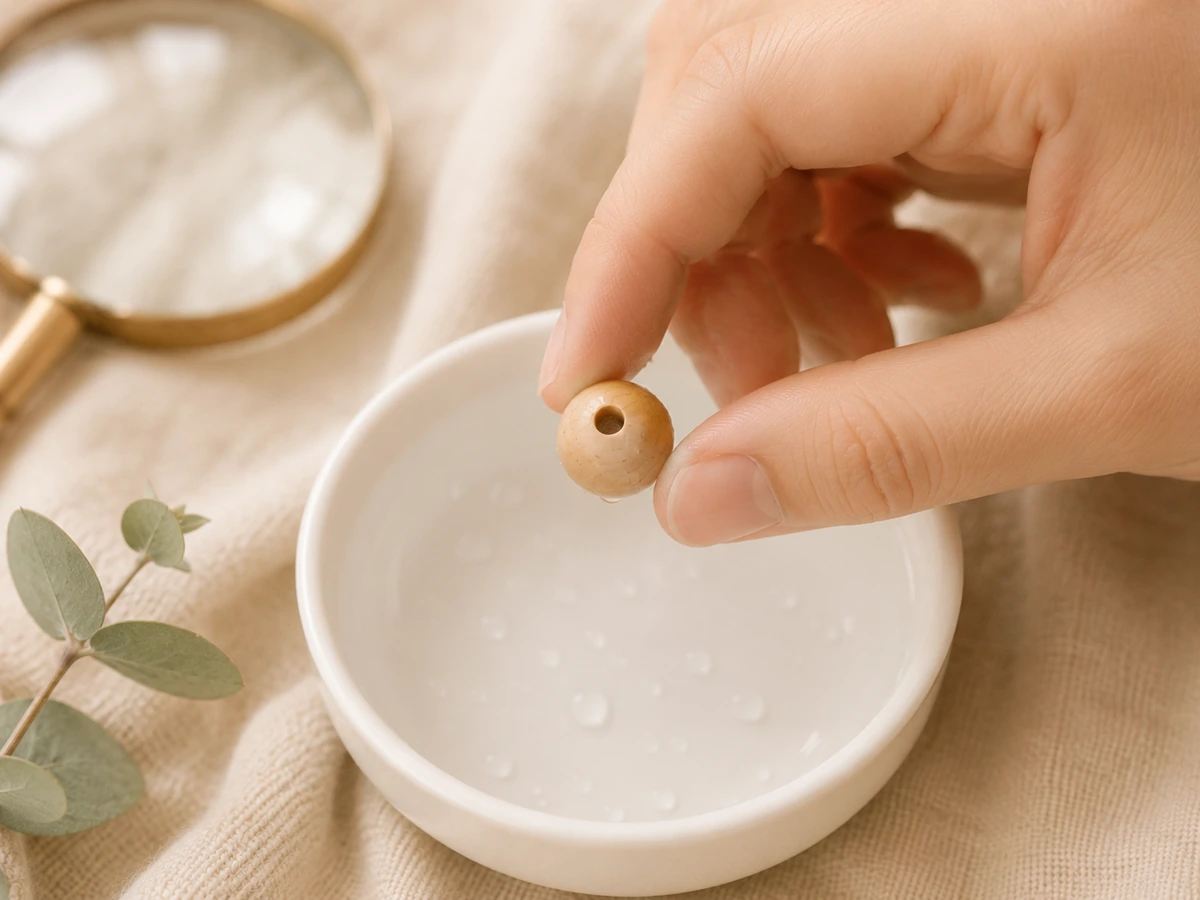
“Saliva-resistant” is everyday shorthand; technically it means DIN 53160-1/-2: sweat and saliva fastness. This tests whether dyes, coatings or finishes leach off when exposed to artificial saliva or sweat. A sample sits in a neutral-pH saliva solution at 37 °C for several hours; the solution is then chemically analysed.
For nursery materials, “saliva-resistant” concretely means:
- Colours are water and light-resistant — they don’t transfer onto skin, mucous membranes or lips.
- No plasticisers, binders or pigments leach out that could be swallowed.
- With wooden beads: the varnish is a saliva-resistant clear coat or food-grade water-based colour.
Important: Saliva-resistant is not automatically food-safe. These are separate tests. For nursery craft materials, saliva-resistance is the relevant metric.
4. Harmful substances checklist before purchasing
Before ordering craft materials for your group, check these five points. For each “no”, ask the manufacturer — reputable suppliers provide proof without hesitation.
- Is a Declaration of Conformity (DoC) available? It references the applicable standards (at least EN 71-1 and EN 71-3) and is signed by the manufacturer.
- Which test lab did the testing? Accredited labs (TÜV, SGS, Eurofins, Intertek) are standard. “Tested internally” is not sufficient.
- Is saliva-resistance explicitly stated? Look for “per DIN 53160” on the datasheet or product page.
- How recent is the test report? For ongoing production, it should be no more than 24 months old — otherwise request a re-test.
- Are small parts marked as hazardous? Mandatory warning for parts fitting inside the small-parts cylinder (31.7 mm diameter, up to 57.1 mm depth).
5. Craft materials for different age groups
The toy standard clearly distinguishes between materials “for children under 36 months” and “from age 3”. This boundary is safety-based, not pedagogical. Here’s a purchasing guide:
| Age | Suitable materials | Avoid |
|---|---|---|
| 0–12 months (nursery) | Grab toys with safety beads 30 mm+, unvarnished wooden rings, mobiles out of reach | Any loose small parts, cords, bells without securely sewn fastening |
| 1–3 years (nursery) | Safety beads ≥ 30 mm, ready-made dummy chains (max. 22 cm), silicone teething rings per EN 71-3 | Loose beads under 30 mm, cords under 30 cm long (strangulation risk), glued felt pieces |
| 3–6 years (kindergarten) | Wooden beads 10–12 mm, letter blocks, novelty beads, craft kits under educator supervision | Unsupervised use of beads under 6 mm, free access to cords over 50 cm |
| 6+ years (pre-school, out-of-school) | Full range including hexagon beads, fine crochet work, cord projects | Responsibility increasingly shifts to the child, but first aid plan stays accessible |
Rule of thumb for nurseries: If a bead falls through a toilet-paper roll, it’s too small. The inside of a paper roll matches roughly the small-parts cylinder in the standard.
6. Safe practice in the nursery setting
Safe materials are half the battle — the other half is the routine you follow in daily practice. These five practical tips work well in many settings:
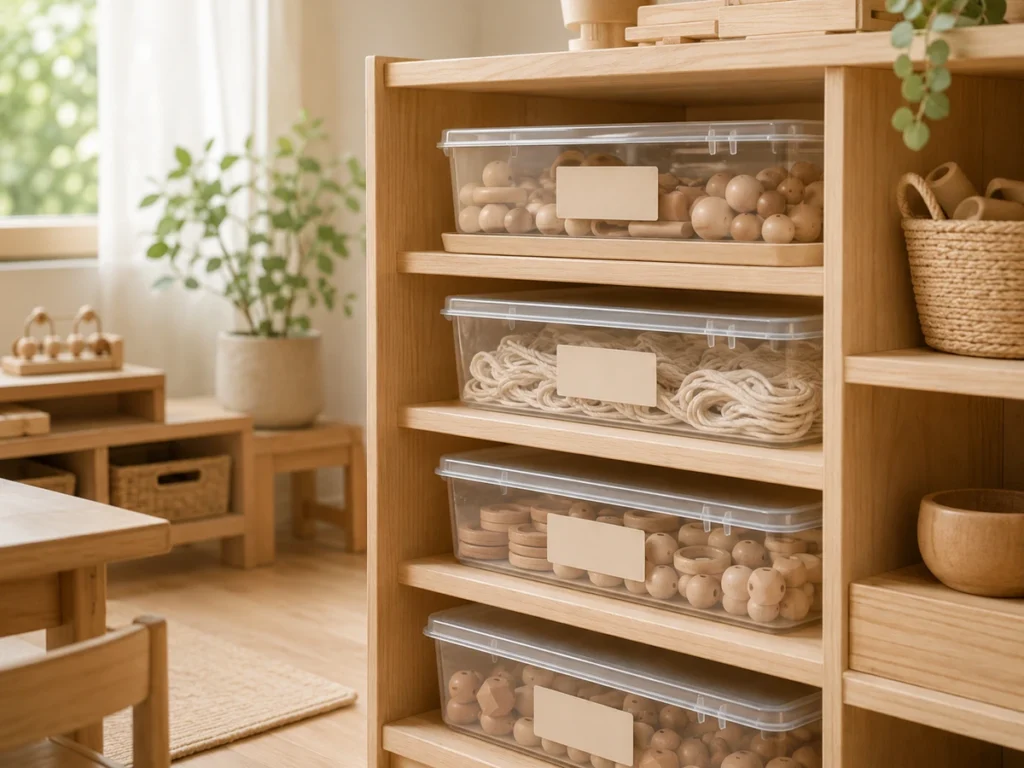
- Age-separated, closed storage: Keep materials for under-3s strictly separate from small parts. Labelled boxes on different shelf heights prevent mix-ups.
- Weekly visual check: Is a wooden bead splintering? Has a knot loosened? A five-minute routine Friday afternoon saves emergencies.
- First aid plan visibly posted: Poison centre number (in the UK: 111, or 999 if a child is seriously unwell) and choking response technique belong in the group room.
- Transparent parent communication: When introducing new materials, share the safety certificates in a notice or parent letter. This builds trust and heads off concerns.
- Keep purchasing records: Keep test reports and declarations of conformity for at least three years — they’re proof of the setting’s due diligence in case of injury.
7. Invoice payment for public-sector organisations: How it works with Kiki-Ena
For nurseries, pre-schools, childminders and schools, we offer straightforward invoice payment. Simply fill in the nursery enquiry form — we verify the organisation and activate invoice payment with 14 days to settle. Safety certificates, declarations of conformity and test reports are available on request as PDFs, and we’re happy to send them before you submit to your management.
FAQ – Common questions from the nursery setting
Are your wooden beads saliva-resistant?
Yes. Our varnished wooden beads are tested per DIN EN 71-3 and DIN 53160 (saliva and sweat fastness). We’ll send the test report on request.
What bead size is allowed for nursery children under 3?
Only safety beads 30 mm diameter or larger, or material permanently secured in grab toys / dummy chains. Loose small beads are only approved from age 3.
What’s the difference between a standard EN 12586 dummy chain and a homemade one?
The standard mandates maximum 22 cm length, 90 N pull test and secure fastening. Homemade chains without this certification cannot be used in nurseries — this applies to parent gifts too.
How do I quickly identify small parts?
Rule of thumb: anything passing through a toilet-paper roll is potentially swallowable. The official small-parts cylinder is 31.7 mm diameter per EN 71-1.
Can we preview safety certificates before ordering?
Yes — request them via the nursery enquiry form or contact our B2B team. We typically email current test reports as PDF within 24 hours.
How long is a test report valid?
As long as the product is manufactured unchanged. For ongoing products, we re-test every 24 months to rule out material drift.
Source safe materials for your nursery with confidence
Safe craft materials aren’t a luxury — they’re mandatory. And they ease your everyday work noticeably. When you buy materials with test reports, you can work with the children more relaxed. Have questions about a specific product? Ask us. We’re family people ourselves and understand nursery life.