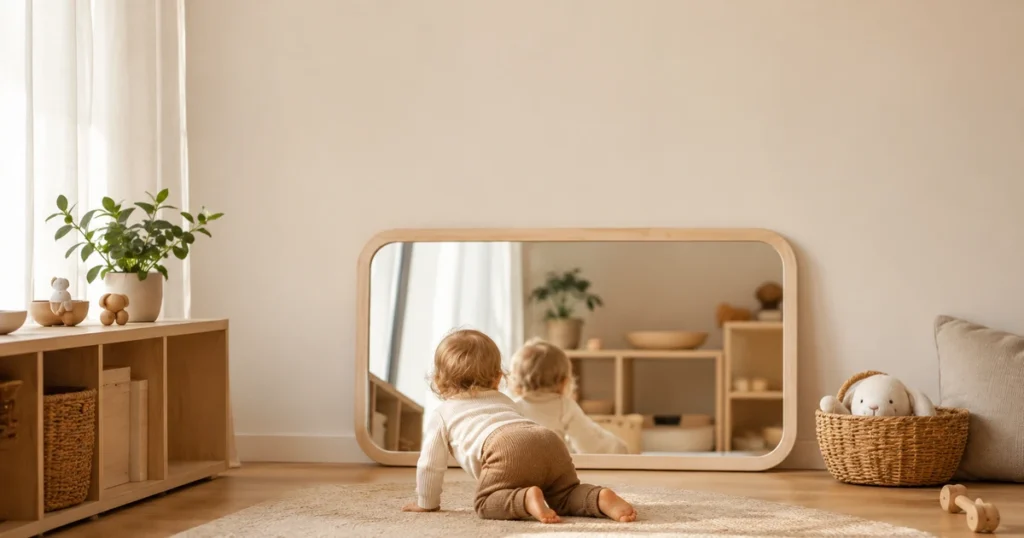

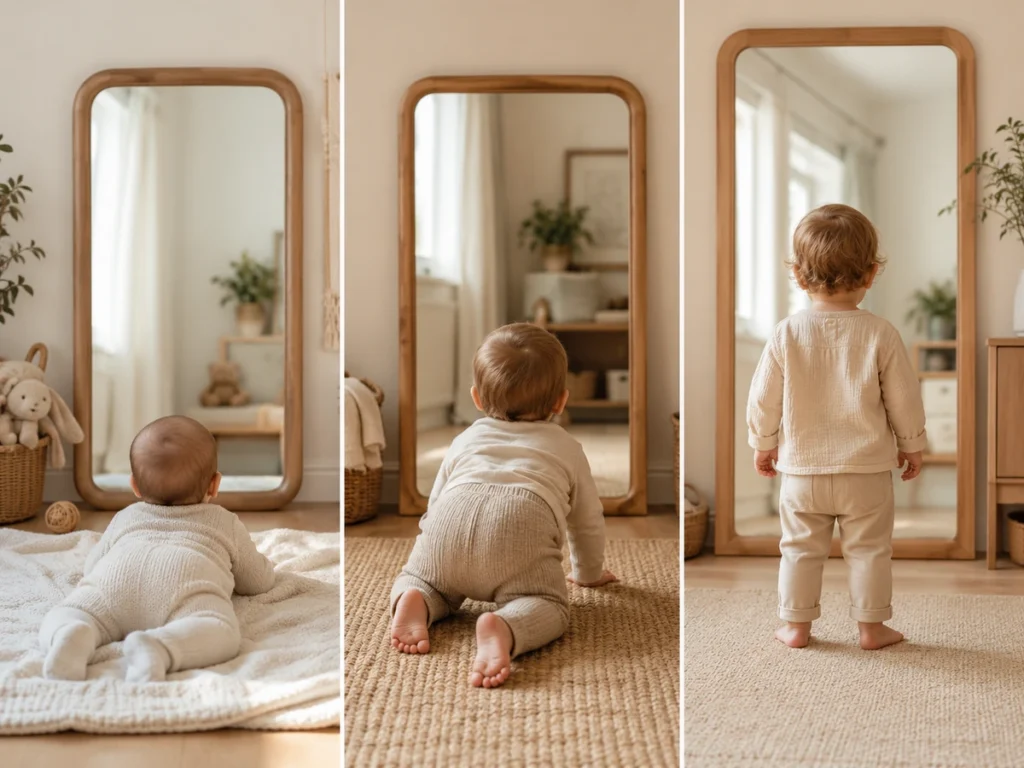
A mirror in the nursery is not a decorative feature but a learning tool. Babies and toddlers develop self-awareness through their reflection, learn to understand facial expressions, and eventually grasp the cognitive distinction between ‘self’ and ‘other’. This article explains why mirrors should be standard equipment in every nursery, what safety requirements they must meet, and which Millhouse mirrors from the Kiki-Ena range work particularly well in everyday nursery settings.
Contents
- Why mirrors in the nursery?
- Developmental milestones with mirrors
- Safety requirements – no real glass
- Millhouse Galaxy Mirror Maple – Profile
- Installation and care
- FAQ
- Enquiries and advice
1. Why mirrors in the nursery?
Mirrors are one of the few pieces of furniture a child can operate independently – and they offer clear learning stimulus too. Three key functions:
- Self-awareness: The child sees themselves and experiences the connection between movement and mirror image.
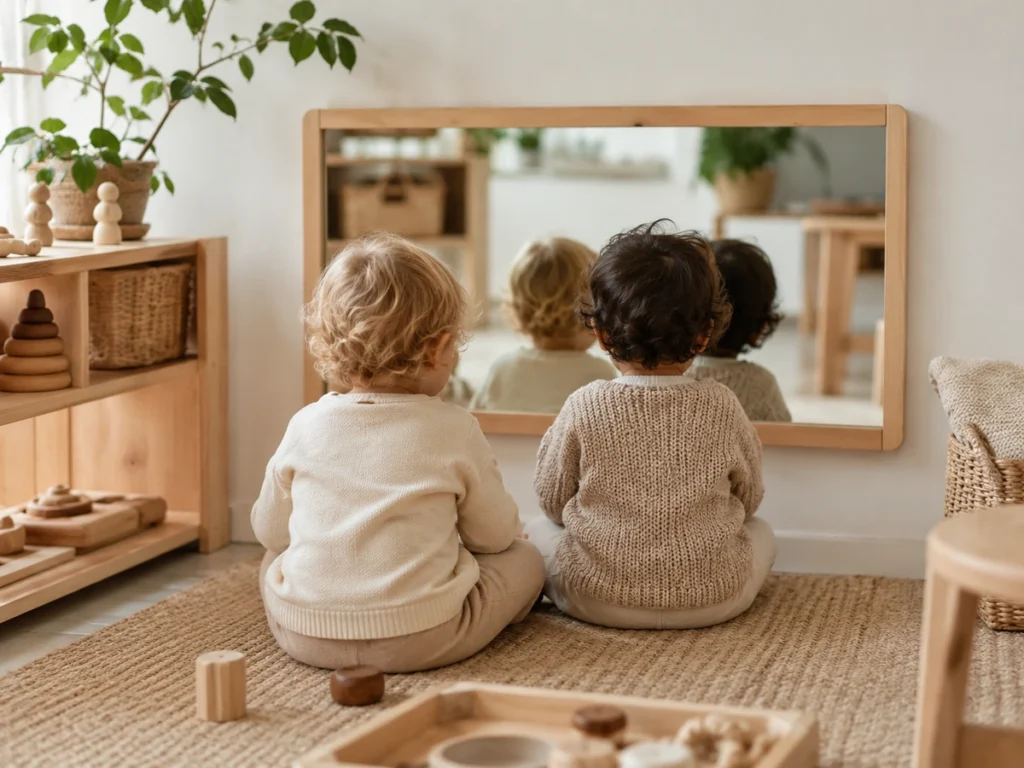
- Social perception: In the mirror, the child can observe the facial expressions of other children or the educator.
- Sensory calming: Mirrors often have a soothing effect in quiet spaces or hideaways, as they provide calm visual activity without animation.
These functions are deliberately used in occupational therapy and early intervention – read more about this in the article Materials for occupational therapy practices.
2. Developmental milestones with mirrors
Children progress through typical developmental stages when exploring mirrors:
- 0–6 months: Recognises movement, watches with curiosity – but doesn’t yet understand they’re seeing themselves.
- 6–12 months: Recognises the mirror image as ‘something interesting’ – begins to interact, reaches out.
- 12–18 months: Starts to understand that the mirror image is linked to their own movement.
- 18–24 months: The famous ‘mirror test’ stage – the child recognises themselves, can wipe away a dot marked on their own forehead.
- 2–3 years: Understands the mirror image as a complete self-representation – begins to ‘see themselves in the mirror’ the way adults do.
These stages only develop when the child spends actual time at the mirror – deliberately planned time, never forced.
3. Safety requirements – no real glass
Real mirror glass has no place in the nursery. When struck, it shatters into dangerous shards. Safety standards require:
- Acrylic mirrors: Shatterproof, lightweight, the standard in most cases.
- Safety laminated glass: When struck, cracks into a web of fractures without splinters breaking free.
- Stable frame with finger guards: Prevents injuries at edges or when children reach inside.
When ordering, check the material specification and CE mark. Read more about safety in the article Craft materials for nurseries: Safety to DIN EN 71.
4. Millhouse Galaxy Mirror Maple – Profile
The Galaxy Mirror Maple by Millhouse is one of the most popular professional mirrors in the German nursery market. Key features:
- Material: Maple-effect melamine frame, acrylic mirror or safety glass (depending on variant)
- Sizes: Several versions from single to multiple mirrors
- Safety: Rounded all over, finger guards built into the frame
- Installation: Wall or floor mounting options available
- Guarantee: 5-year manufacturer’s guarantee (Millhouse standard)
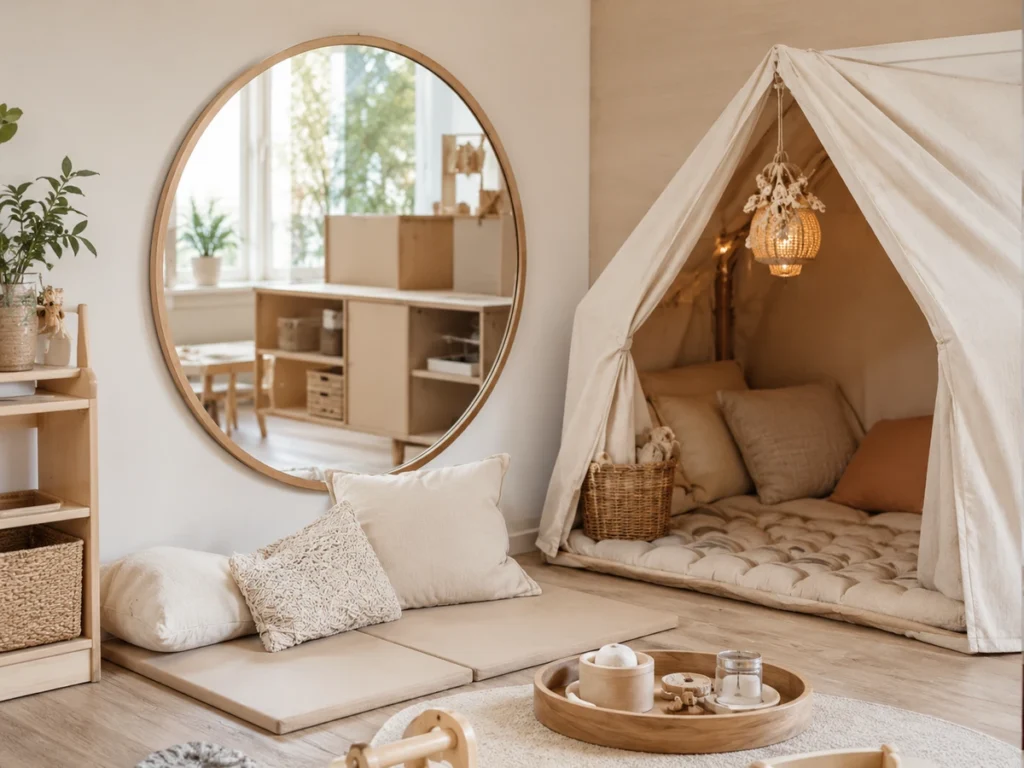
The maple finish works with almost any nursery design because it looks light, neutral and warm. Combined with a Cosy Cove hideaway, it creates a complete sensory play area.
5. Installation and care
Installing a nursery mirror needs care:
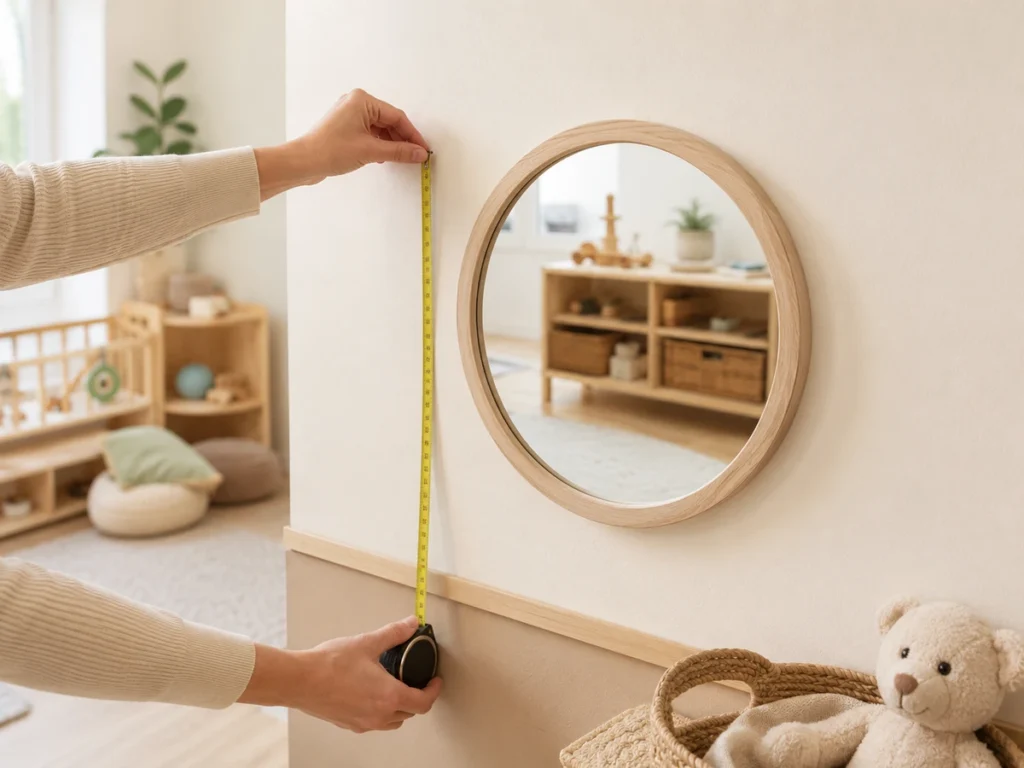
- Height: Bottom edge about 30–40 cm from the floor, so crawling children can also see themselves.
- Fixing: Use wall plugs in a load-bearing wall, never plasterboard alone. Use anti-tip securing for floor-standing models.
- Position: Avoid placing directly opposite doors or windows – otherwise glare from reflections.
- Sightline: Educators should be able to see both the mirror and the child in front of it at the same time.
Care is simple: wipe weekly with soft, lint-free cloth and mild cleaner. Don’t use abrasive products – they scratch acrylic mirrors.
FAQ
From what age is a mirror useful?
From the crawling stage (around 6 months) it can be used intentionally, with adult support even earlier.
How many mirrors does a nursery group need?
One central wall mirror and possibly a smaller one in the sensory area. Two is usually plenty.
Is the Galaxy Mirror Maple safe for children when installed?
Yes, with proper installation (wall plugs in load-bearing wall). The floor-standing version has integrated anti-tip securing.
What does it cost?
Professional wall mirrors in nursery format cost around 150–450 euros depending on size and finish. For group orders, a nursery enquiry makes sense.
Enquiries and advice
Kiki-Ena stocks Millhouse mirrors in several versions and advises on room integration. Submit an enquiry via /kita-anfrage/ or browse the Eduplay range and Kindergarten & Nursery.