
1. The Chemistry Behind Silicone — at a Glance
Silicone is a synthetic material made from the element silicon, bonded with oxygen to form polysiloxane chains. Unlike many other plastics, the silicone backbone structure Si-O-Si is chemically extremely stable – it doesn’t break down under UV radiation, heat up to 200°C, or contact with acids or bases. This stability is why silicone is used so widely in industry, from motor oil seals to baking tins.
For liquid silicone to become a solid object, it must be cross-linked – in chemical terms, individual polymer chains are bonded together. It’s at this cross-linking stage that food-grade silicone fundamentally differs from standard silicone.
2. Platinum-Cured vs. Peroxide-Cured: The Critical Difference
There are two main methods for cross-linking silicone:
Peroxide cross-linking uses organic peroxides as a catalyst. It’s cheap and widely used industrially. The downside: the cross-linking process generates by-products – so-called breakdown products – that remain in the finished silicone. These include benzoic acid, methyl benzoate, and phenethyl acetate. In small quantities, these substances can migrate into adjacent food or saliva. Peroxide-cured silicone is therefore suitable for industrial seals, tubing and technical applications, but not for direct food or mouth contact.
Platinum cross-linking uses a platinum catalyst. The advantage: the reaction produces no by-products. The finished silicone is pure, flavourless, odourless and chemically inert. This platinum-cured silicone is exactly what you find in dummy chains, teething rings, baby spoons and medical devices. It’s also called ‘Platinum-Cured Silicone’ or, in English, ‘Medical-Grade’ or ‘Food-Grade’.
The manufacturing process is considerably more expensive – platinum is a precious metal – and this is exactly where the price difference comes from: a 12mm standard silicone bead costs just a few pence in bulk, whereas the same component in platinum-cured silicone costs three to five times as much.
3. Which Standards Apply?
In the EU, three key standards apply to baby toys with mouth contact:
- EU Regulation 10/2011 – the EU regulation on materials and articles made of plastic intended to come into contact with food. It defines migration limits for relevant substances.
- FDA 21 CFR 177.2600 – the US food authority approval for ‘Rubber articles intended for repeated use’. It’s also cited in Europe as an additional quality marker.
- DIN EN 71-3 – the toy safety standard mentioned earlier for heavy metal migration. It applies to silicone components in baby toys independently of food standards.
High-quality silicone beads for dummy chains and teething rings meet all three standards. Some manufacturers additionally state that the silicone is BPA-free, phthalate-free, latex-free and PVC-free – these aren’t separate tests, but rather consequences of the platinum-cured method.
4. How to Spot Food-Grade Silicone in Everyday Life
Five characteristics will help you when shopping:
- Smell test: Genuine platinum-cured silicone is odourless. If you smell a silicone bead and it has a slightly chemical, rubber-like smell, that’s a sign of peroxide cross-linking with residual components.
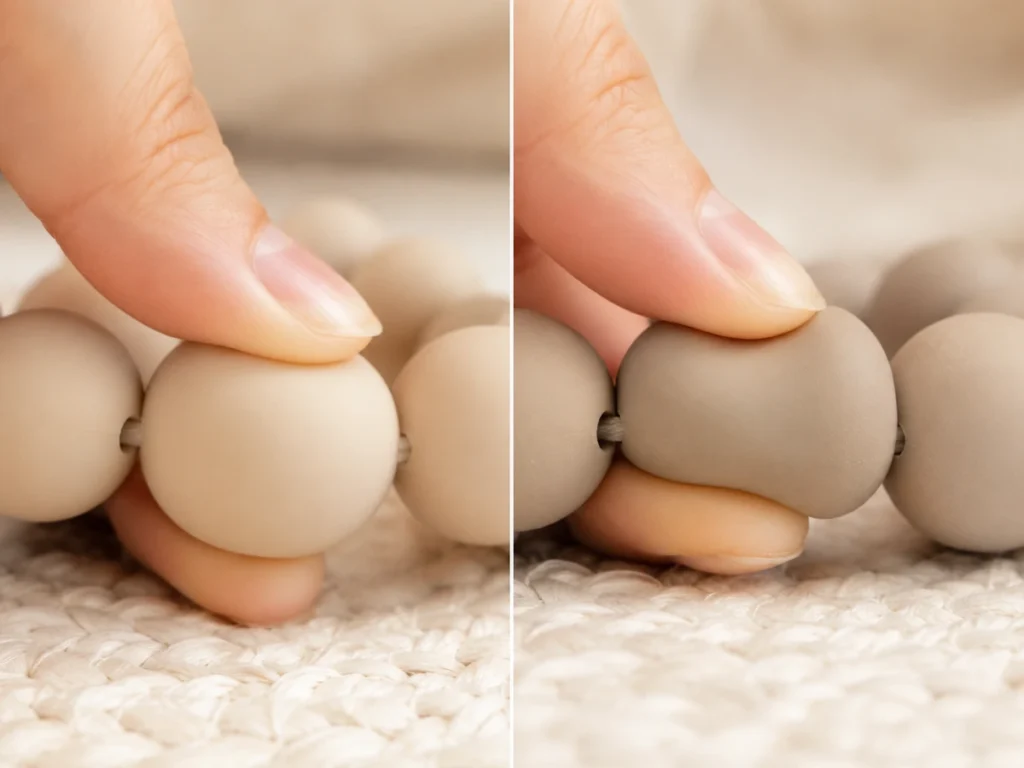
- Squeeze test: Press the silicone hard and let go. Platinum-cured silicone springs back instantly to its original shape without any deformation marks. Standard silicone may leave a brief indent or turn white at the bend (the so-called ‘stretch test’).
- Manufacturer information: Look for specific standards in the product description – ‘complies with EU Regulation 10/2011’ or ‘FDA 21 CFR 177.2600’ are reliable indicators. ‘Food-safe’ without a reference is just marketing speak.
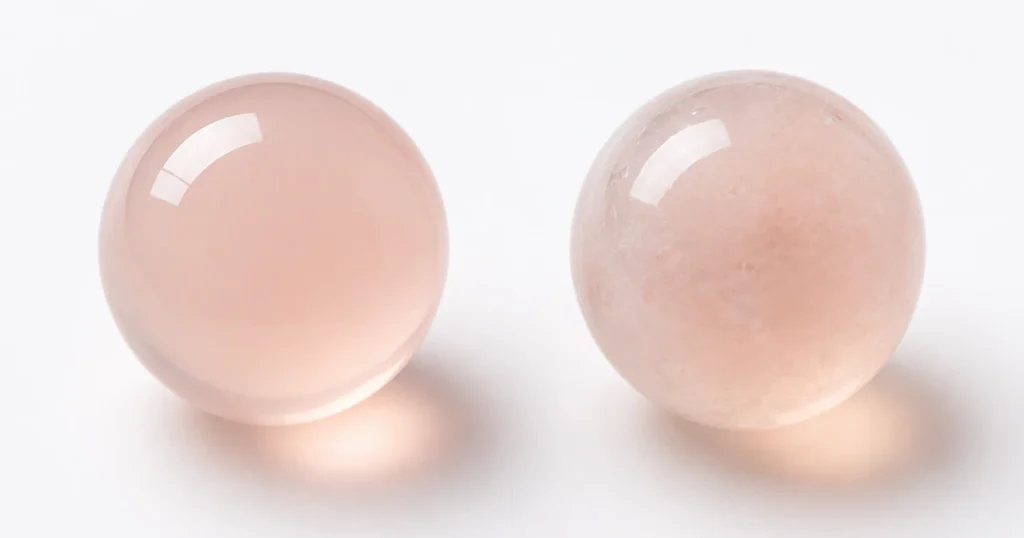
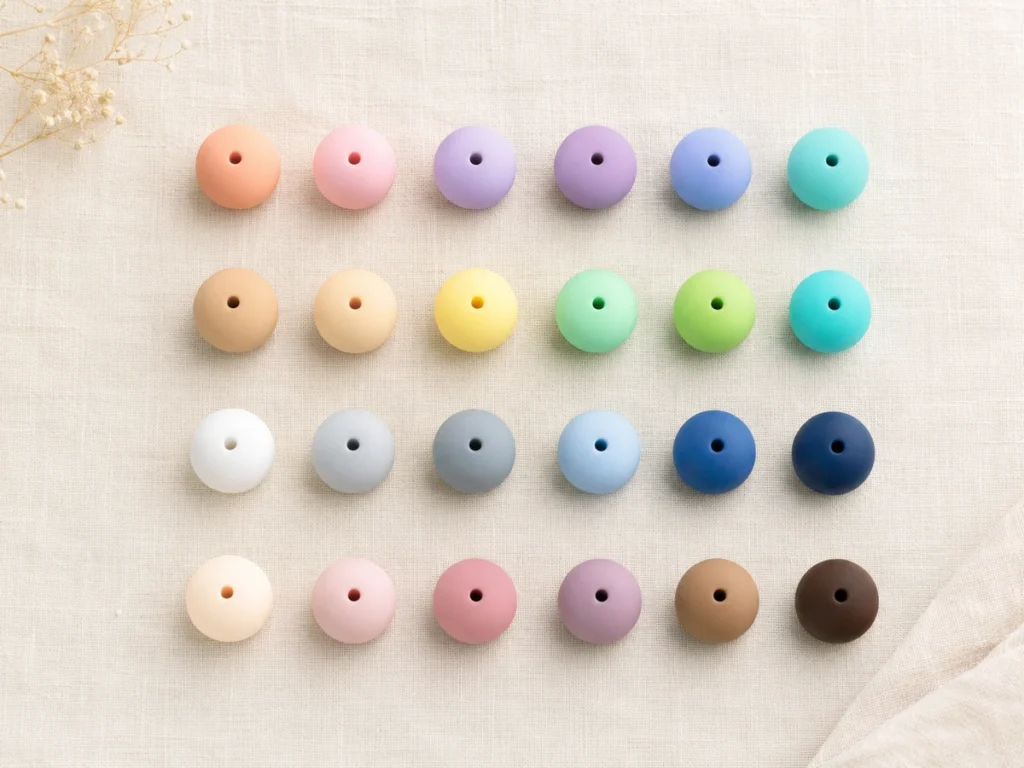
- Colour and clarity: Platinum-cured silicone has pure, clear colours without cloudy streaks. Pigments are evenly distributed. With cheap silicone, you sometimes see colour differences within the same bead.
- Price: As with wooden beads, the rule stands: if someone’s selling 100 silicone beads for €5, they can’t economically carry out platinum cross-linking. A reputable silicone bead costs between €0.30 and €1.20 per piece.
5. What Does This Mean in Practice?
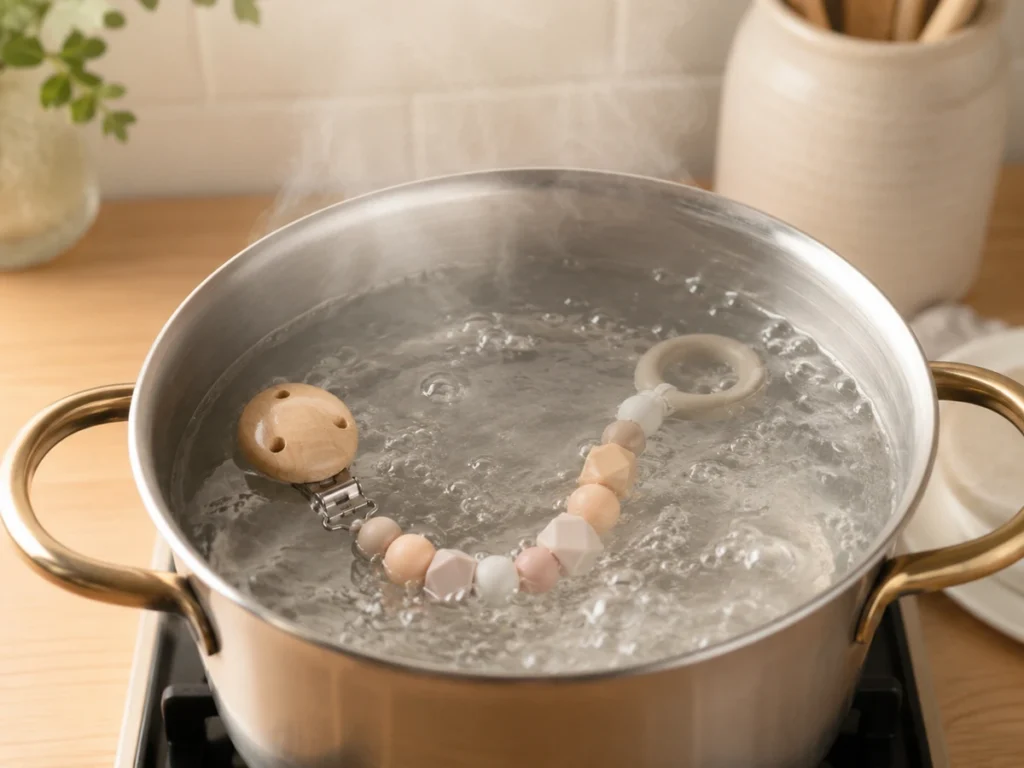
If you have a dummy chain or teething ring made from high-quality food-grade silicone, using it is extremely straightforward. The material can withstand temperatures from minus 60 to plus 230°C. You can easily sterilise the beads in boiling water, put them in the dishwasher, or even chill them in the freezer if needed (particularly helpful for teething rings to soothe sore gums).
Unlike wooden beads, silicone beads don’t swell or absorb water. This makes them particularly low-maintenance. However, silicone can build up static charge and attract dust – a damp cloth and perhaps a drop of mild washing-up liquid are all you need to get the beads clean again.
Compared directly with wood, silicone has different advantages (softer, quieter, easier to clean) and different drawbacks (less weight, slightly less durable with intense chewing). Our comparison article Timber vs. Silicone will help you work out which material suits you best.
FAQ — Food-Grade Silicone
Is ‘BPA-free’ the same as food-grade?
No. BPA-free only means it contains no bisphenol A. Food-grade silicone is BPA-free plus phthalate-free plus latex-free plus meets EU migration limits. ‘BPA-free’ alone is therefore the weaker indicator.
Does Silicone Change Over Time?
High-quality platinum-cured silicone is UV-stable and barely ages. With very long and intensive use, the surface may become slightly duller. If a silicone component becomes sticky, discoloured, or shows cracks, that’s a sign of poor quality and the item should be replaced.
Can Silicone Be Cooked Without Releasing Harmful Substances?
Yes, as long as it’s genuine food-grade silicone. It remains stable up to 230°C and even when cooking, releases no measurable amounts of migration substances. This is precisely why silicone is used in baking tins and baby food containers.
Are Silicone Beads Safe for Children Under Six Months?
Safe in terms of the material – yes. However, as with all craft components, a dummy chain must be no longer than 22 centimetres, and individual beads must pass the small parts test of DIN EN 71-1. Our standard silicone beads at 12mm diameter meet this requirement.
Can I Mix Silicone and Wood in a Dummy Chain?
Yes, it’s a very popular combination. Just make sure the hole diameters match (the standard is 2mm) and the cord doesn’t rub against a sharp edge where they meet. More tips in our comparison article.
Looking for food-grade silicone beads? Our silicone products are platinum-cured and comply with EU Regulation 10/2011 and FDA 21 CFR 177.2600. Be sure to check out our material comparison Timber vs. Silicone too.