
1. At a glance – the comparison in 30 seconds

If you’re short on time: this table is enough for an initial overview. The details come below.
| Criterion | Wooden beads | Silicone beads |
|---|---|---|
| Weight | Light (beech wood) | Medium to heavier per bead |
| Hardness / bite feel | Firm, doesn’t give way | Soft, slightly yielding |
| Hygiene / cleaning | Damp cloth, no water bath | Washable, can be boiled |
| When teething | Cool & smooth, but hard | Soft, doesn’t cool as much |
| Appearance | Classic, warm, natural | Pastel, modern, colourful |
| Maintenance | Requires more care | Straightforward |
| Price per chain | Usually cheaper | Slightly more expensive |
| Safety (DIN EN 12586) | Achievable if safely waxed | Achievable if food-safe |
So both are safe and practical for everyday use – but they show their strengths in different situations.
2. Wooden pacifier chain: strengths + weaknesses


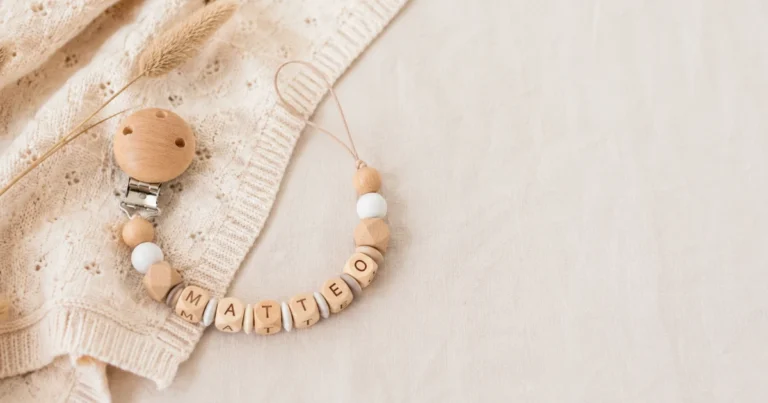
Wood is the classic material. Beech wood, turned, smoothly sanded, often sealed with a thin layer of food-safe beeswax or plant oil. The result: a bead that feels warm in the hand, is lightweight and feels familiar to the touch straight away. Many mums choose wood too because it matches the look of the nursery – natural tones instead of bright colours.
Sensorially, wood has a real advantage: it picks up body warmth and responds to touch. Babies love that. It clicks as it moves, each bead has a slightly different grain pattern, and it smells gently of – nothing. Which is good, because your baby puts it in their mouth.
The weakness: wood and water aren’t friends. A wooden chain shouldn’t go in the dishwasher, steriliser or a prolonged water bath. It becomes rough, can crack and loses its wax seal. Cleaning is done with a damp cloth, with a drop of gentle baby soap if needed – then dry thoroughly, best in the air. If you don’t pay attention to this, after a few weeks you’ll have a dull, rough chain.
Plus wood is hard. For teething, this isn’t pleasant for every baby – some prefer to chew on something that gives. Allergy-conscious parents often ask: beech wood is hypoallergenic, provided the seal has been tested to EN 71-3 (no heavy metals, no harmful varnishes).
3. Silicone pacifier chain: strengths + weaknesses


Silicone beads are the newer material – and they’ve quickly established themselves. Food-safe silicone is BPA-free, phthalate-free, flavourless and above all: completely waterproof. You can rinse a silicone chain under hot water, briefly boil it or sterilise it in a steriliser. For parents who take a pragmatic approach to hygiene, this is a real plus.
Silicone also scores when it comes to teething: the surface yields slightly, is soft enough for sensitive gums and cools noticeably after a spell in the fridge. Many babies grab the silicone beads of a pacifier chain between their cheeks when their first teeth are coming through. It’s not the chain’s main purpose – but it doesn’t harm it either.
The look is a matter of taste. Silicone comes in muted pastel shades: sage, dusty rose, sand, mustard, anthracite. If you’re after a Scandinavian look, there’s lots of choice here. If you prefer natural wood, there isn’t.
The weakness: weight. A silicone bead is heavier per piece than a wooden bead of the same size. A pure silicone chain of 8–10 beads is noticeably heavier than a wooden chain – not dramatically, but noticeably for younger babies (3–6 months). Plus the feel is less natural: silicone feels rubbery, not warm like wood. Matter of taste, of course.
4. When wood is the right choice


- You like natural materials. Wood goes with solid wood furniture, linen, wool, neutral colours.
- You’re giving the chain as a gift. A personalised wooden pacifier chain with a name looks more classic and lasting than a gift in pastel silicone.
- Your baby is very young (under 4 months). Every gramme counts – wood is lighter.
- You value simplicity. Wooden beads can be produced without allergen concerns and contain no plastic.
- You’re planning to make the chain yourself. Wooden beads are the traditional DIY material – more choice, more sizes, more designs.
5. When silicone is the right choice

- Your baby is teething heavily. Silicone is softer and more comfortable on sore gums.
- You want hygiene to be straightforward. Boiling, rinsing, sterilising – all worry-free.
- You’re often outdoors, at the beach, by the water. Sand and splashing water aren’t a problem for silicone.
- You like modern pastel aesthetics. Silicone offers more colour options.
- The chain gets heavy daily use. Silicone withstands saliva, spit-up milk and the occasional tumble without damage.
6. Hybrid: wood + silicone combined

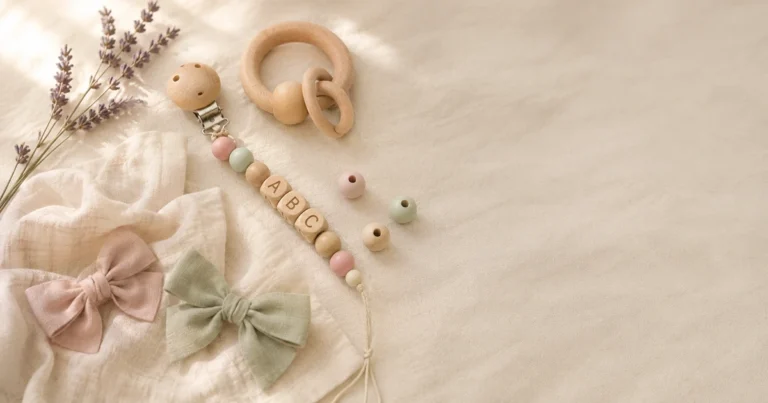
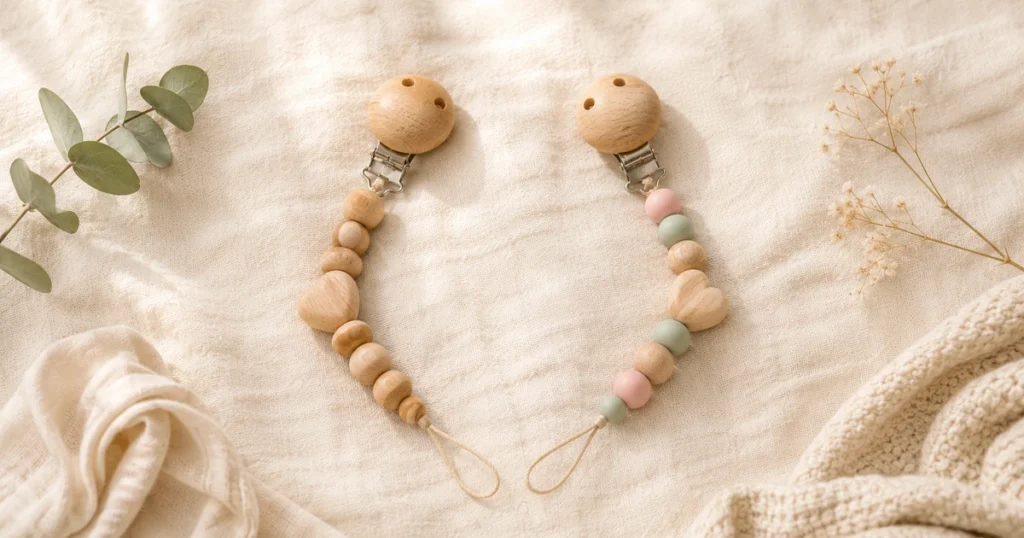
The honest answer many parents give to the material question is: both. Hybrid pacifier chains combine a few wooden beads with two or three silicone feature beads (like a heart or star in a pastel shade). You get the warm natural feel of wood – and a soft chewing point in silicone if your baby is teething. The look is often nicer than the pure version too: natural wood next to a pastel accent breaks up the austerity.
Care-wise, treat a hybrid chain like a pure wooden chain: a damp cloth is enough. You can rinse the silicone part separately under water – but not the wooden beads. If you’re making a hybrid chain yourself, you’ll find the components in our craft kits.
7. Safety: What both must have in common
Regardless of material – these four points are non-negotiable. They apply to every pacifier chain sold in Germany:
- DIN EN 12586 – pacifier holder standard. Maximum length 22 cm, measured from the clip to the inside of the pacifier ring. This limit is a safety boundary against strangulation, not a recommendation. We build our chains to 18–20 cm as standard – shorter is not only safer, it also hangs better.
- EN 71-3 – harmful substance testing. Regulates the migration of heavy metals from varnishes, dyes and materials. Both wooden and silicone beads must comply with this standard. When buying materials, look for the note ‘tested to EN 71-3’.
- Saliva-resistant surface. Varnishes, waxes and coatings must be saliva-resistant – a baby puts the beads in their mouth. Food-safe beeswax (wood) or food-safe silicone meet this requirement.
- No nickel in the wooden clip. If the pacifier clip contains metal parts (spring mechanism), these must be nickel-free. With pure wooden clips (35 mm) this isn’t an issue.
You can find more on standards, lengths and material testing in our comprehensive Pacifier Chain Guide.
FAQ
Are silicone beads really BPA-free?
Food-safe silicone is naturally BPA-free and phthalate-free. The word ‘food-safe’ on the packaging is important – industrial silicone (e.g. from hardware stores) doesn’t meet this requirement.
Can a wooden chain go in water if it’s sealed?
A quick rinse under cold water won’t hurt, but we advise against it. Even a sealed wooden bead absorbs moisture with prolonged water contact and loses wax. A damp cloth is enough.
Which material is more durable?
With proper care, both will easily last through the entire dummy phase (12–24 months). Wooden chains develop a patina over time – some parents like this, others find it annoying. Silicone stays visually consistent.
What’s safer when teething?
Neither is ‘safer’ – both aren’t primarily designed as teething rings. If you want a proper teething ring, buy one separately. But silicone is gentler on the gums when occasionally chewed on.
Can I mix wood and silicone without it looking tacky?
Yes, if the colours work together. Natural wood harmonises particularly well with muted pastel shades (sage, sand, dusty rose). Bright silicone colours next to untreated beech wood often look chaotic – that’s a matter of taste, but a good tip for crafters.
Made your decision? Product links below
You’ve got the material – now you just need the chain. You’ll find both options here:
Or you can build your own – with our craft kits or straight from the general pacifier chain category. If you’re still undecided, it’s best to read the pillar guide first: we go deeper into standards, care and choice there.