
1. What DIN EN 71-1 really tests
EU Toy Directive 2009/48/EG requires every toy for children under 14 to demonstrate safety. The technical implementation is handled by the EN-71 series. While DIN EN 71-3 covers chemical safety (heavy metals, migration), DIN EN 71-1 focuses exclusively on physical and mechanical properties. This covers six areas: choking hazards from small parts, sharp edges and points, tensile strength of cords and strings, breaking behaviour under stress, assembly of fasteners and safe moving parts.
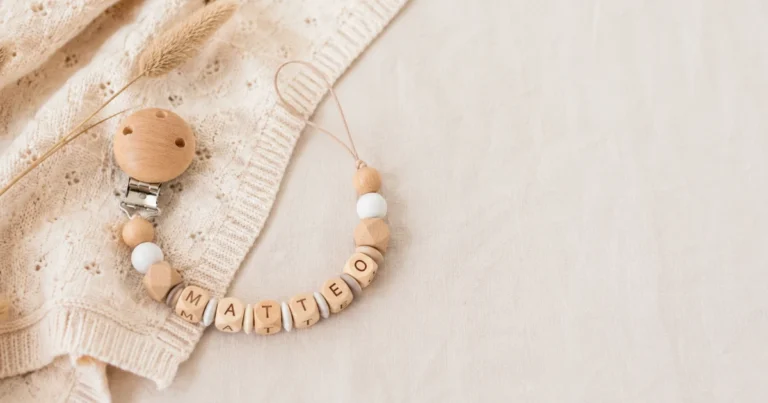
In practice: a wooden bead must not only survive normal play, but also shouldn’t shatter if a toddler gnaws on it with their teeth or a finished dummy chain is yanked hard from a high chair.
2. The tensile strength test: 90 Newtons, a measuring tape and a simple lever
Dummy chains, teething rings and anything attached to a cord go through the classic tensile strength test. The connection between cord and fastener is pulled apart with a defined force. For dummy chains the standard is: 90 Newtons over 10 seconds—that’s roughly equivalent to 9 kilograms of weight. If the knot or connection holds without any parts coming loose, the test is passed.
Why 90 Newtons? Research from Scandinavia has shown that a toddler can briefly generate up to 70 Newtons of force on a fastening during play—the standard therefore adds a safety margin on top. That’s precisely why we use safety beads with internal knots at Kiki-Ena: even if friction from the cord loosened the outside knot, it cannot pull through the tight bore of the safety bead.
3. The small parts cylinder: the simplest, cleverest test tool
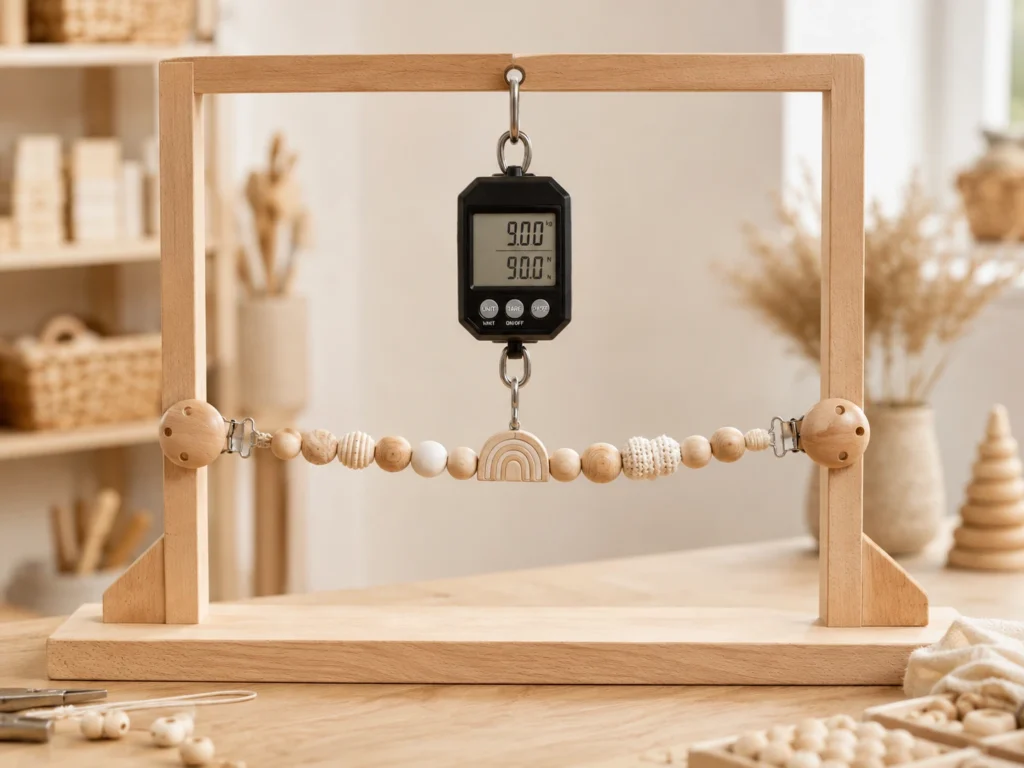
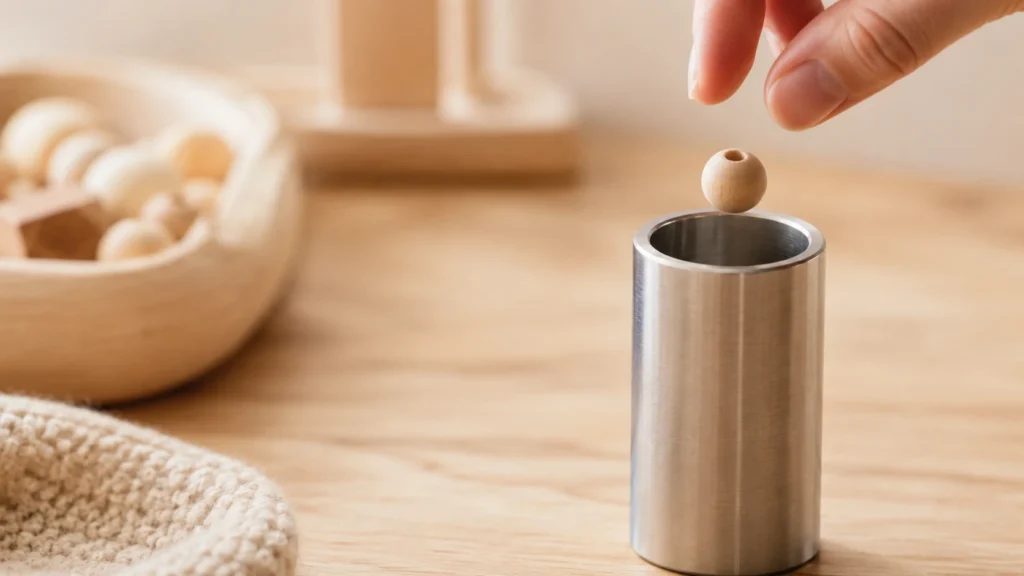
Probably the most important test object in DIN EN 71-1 is absurdly simple: a straight hollow cylinder 31.7mm in diameter and 25.4mm in internal depth. It simulates the upper throat of a toddler under three years old. Any toy part that falls completely into this cylinder is considered a choking hazard and is forbidden for the 0-36 month age group.
That’s why tiny bells, mini wooden beads under 12mm and untested buttons have no place in a dummy chain. Our standard wooden beads from 12mm diameter pass the test easily. With silicone beads and novelty beads, we also ensure that no microparticles are created even under heavy chewing that would fit into the cylinder.
4. Sharp edges, points and hidden fracture lines
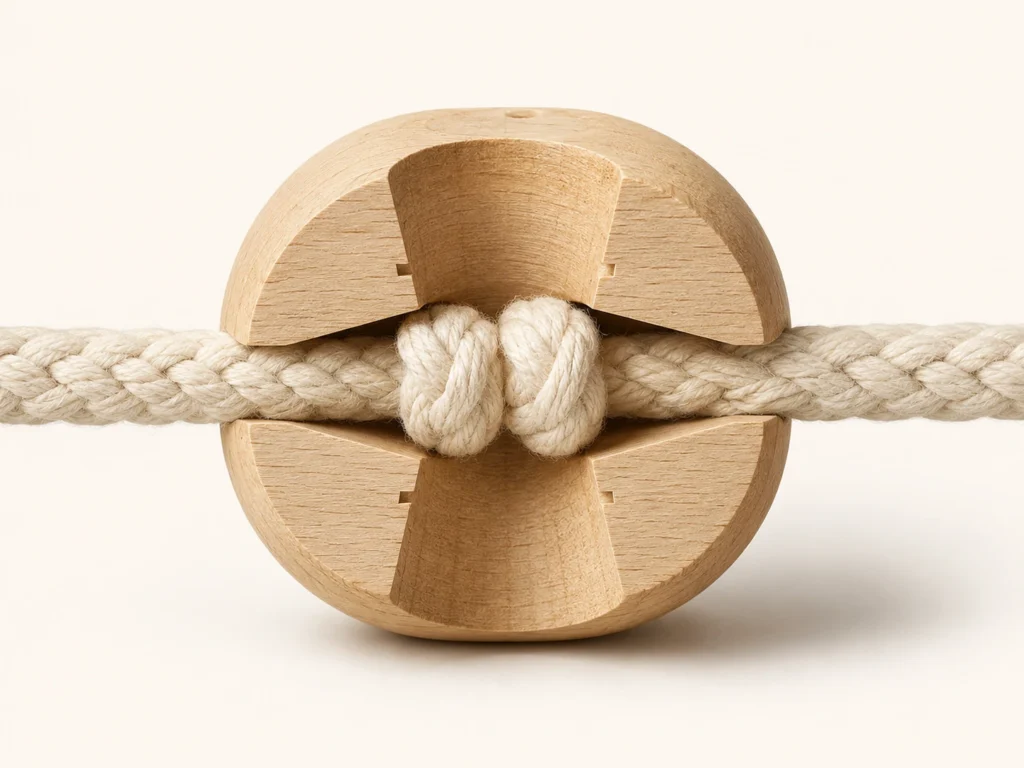
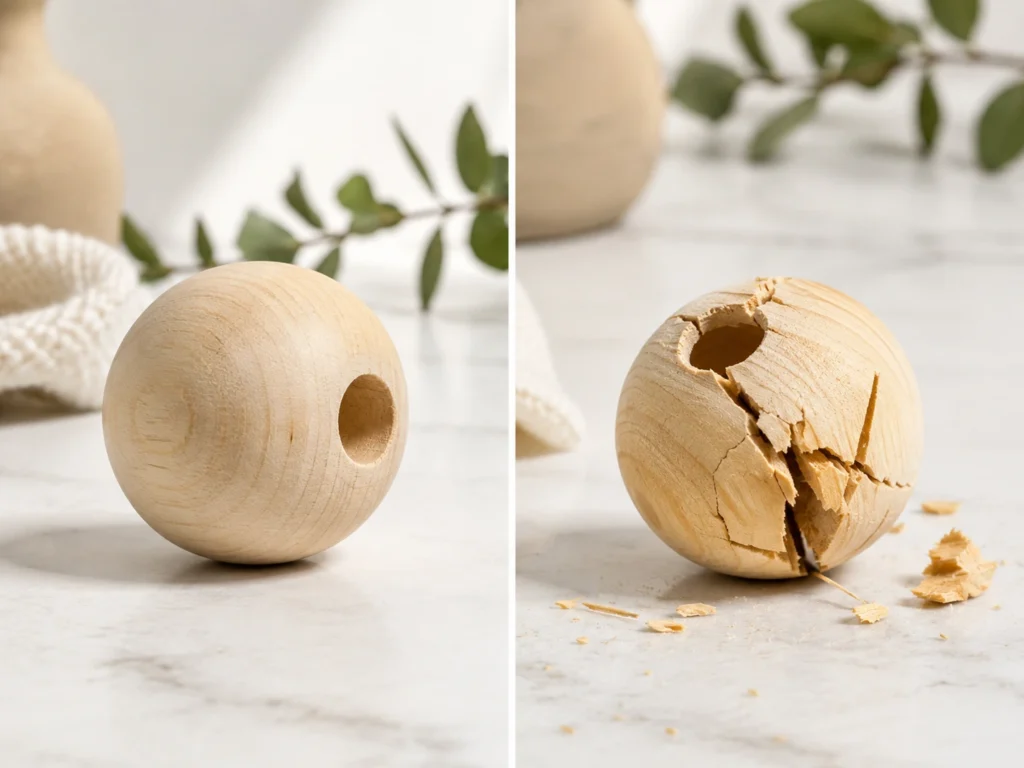
The standard clearly defines what counts as a “sharp edge”: any edge that cuts through a standardised test material within 50mm of rotation is not allowed. For wooden beads this means: the bore must be burr-free, the outer edges are rounded and the finish doesn’t splinter if the bead falls from 1 metre onto a stone floor.
This drop test is precisely why high-quality wooden beads made from maple cost significantly more than cheap imported goods made from soft tropical woods. Maple is one of the hardest domestic hardwoods with a Brinell hardness of around 30 N/mm². It doesn’t splinter, the bore stays clean and the colour doesn’t flake off—even after years of intensive use.
5. What this means for crafting at home
You’re not buying a finished dummy chain, you’re assembling it yourself from tested individual parts. This means you ultimately bear responsibility for the mechanical safety of your finished product. That’s not a big deal if you follow three rules:
- Double-secure your knots: Even though the safety bead hides the knot—tie a double knot and pull it tight before you sink it into the bead. A quick test pull of about 5 kilograms on the finished chain tells you if everything holds.
- Check your material mix: If you’re combining wood and silicone, make sure the bore diameters match. A bore that’s too tight leads to friction wear on the cord—see our wood and silicone comparison.
- Stick to the 22cm rule: According to DIN EN 12586, the total length of the dummy chain must not exceed 22cm (measured without clip). That’s not a suggestion, it’s a hard anti-strangulation limit.
If you follow these three points and use only materials tested to DIN EN 71-1 and 71-3, you’ll end up with a toy that meets an industrial safety standard—just with your personal design touch.
FAQ — DIN EN 71-1 mechanical safety
Is DIN EN 71-1 a legal requirement in Germany?
The standard itself isn’t a regulation, but it’s the technical standard used to implement the legally binding Toy Directive 2009/48/EG. Anyone who tests to EN 71-1 and can prove it meets the mechanical requirements of the Directive.
What’s the difference between DIN EN 71-1 and DIN EN 71-3?
EN 71-1 tests mechanics (small parts, tensile strength, edges). EN 71-3 tests chemistry (migration of 19 heavy metals and harmful substances). Both standards complement each other; a fully tested toy meets both.
Does the standard apply to homemade dummy chains?
For personal use, there’s no legal testing requirement. As soon as you sell or gift the chain, it falls under the Toy Directive and you’re responsible for meeting the safety requirements.
How do I know if a craft material is really tested?
Reputable suppliers state the testing in the product data sheet or provide a conformity certificate. At Kiki-Ena, every craft material is tested to EN 71-1 and 71-3 and made in Germany—we provide certificates on request.
Can a bead pass testing and still break?
Theoretically yes, as material fatigue works over years. That’s why we recommend checking dummy chains and teething rings every 6 to 12 months for cracks, loose knots and discolouration, and replacing them if worn.
Planning your own craft project? Check out our dummy chain guide or browse our tested wooden beads and dummy clips directly.