
1. Why make a baby bottle charm in the first place?
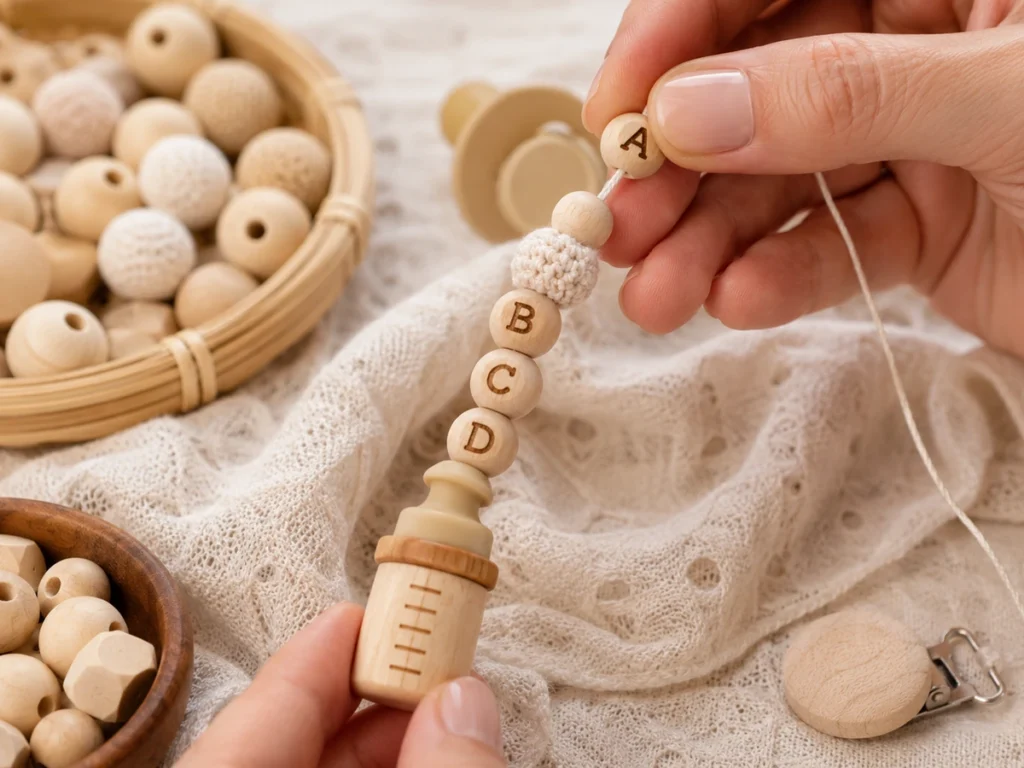
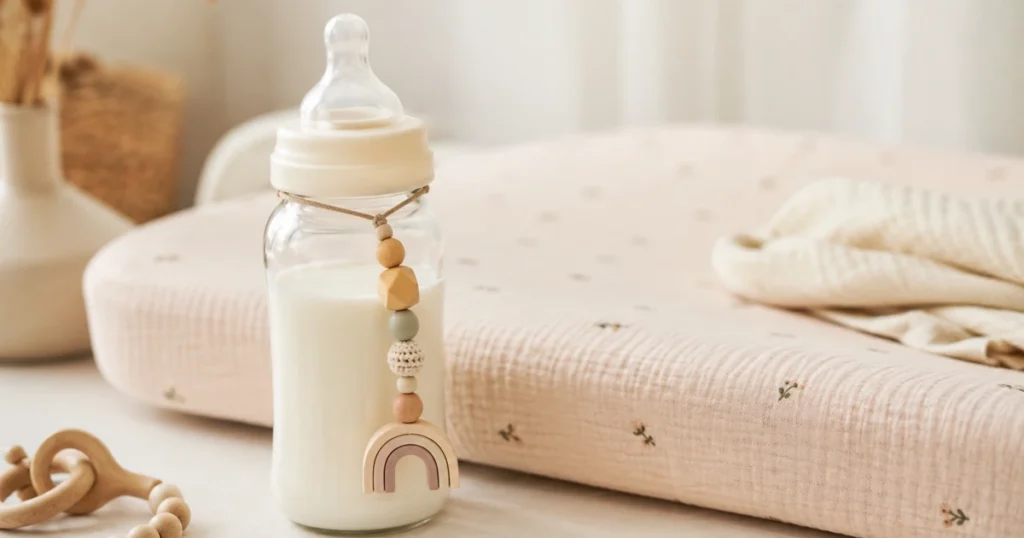
Several reasons. The practical one first: in toddler groups, childminders or nursery, all baby bottles look more or less the same. A charm with a name stops the big mix-up. You avoid arguments, and your child gets their own bottle back.
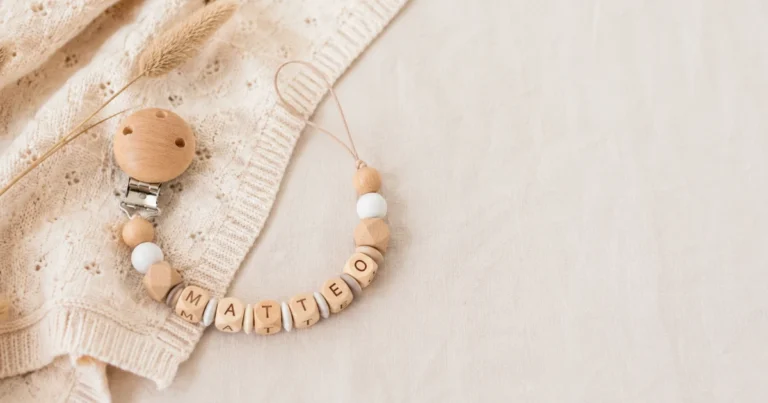
Then there’s the emotional reason: a homemade charm turns a mundane everyday object into something personal. The bottle becomes “mine”. Babies feel that. So do mums and dads.
And finally the gift reason: a charm costs very little, is made quickly and is always welcome. Perfect for the mum friend who’s just had a baby. Or as a small addition to a bigger baby gift.
2. Materials for the charm
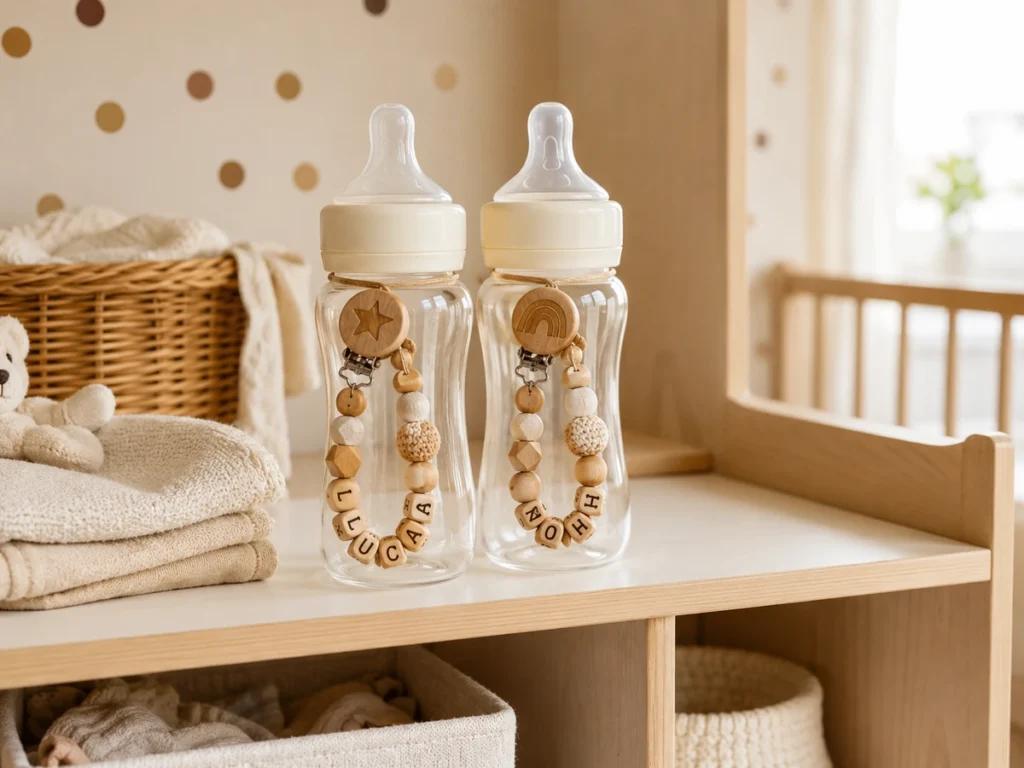
The good news: you need very little.
- A tear-resistant polyester or satin cord (approx. 15 cm)
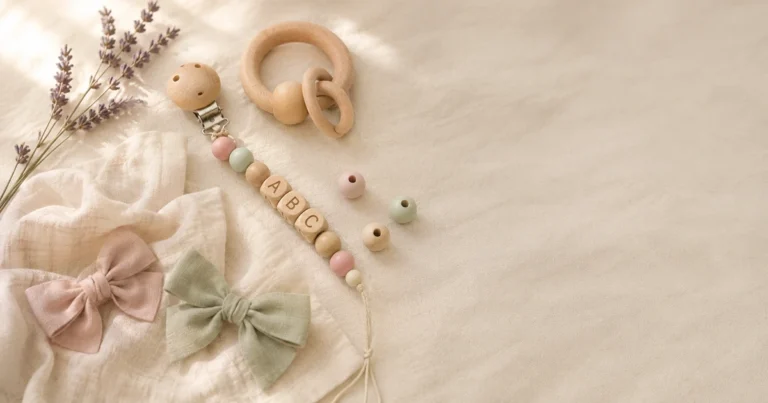
- Four to six wooden beads (10 mm to 12 mm)
- Letter beads for the name
- Optional: a small motif bead detail (star, heart, little animal)
- A safety bead for hiding the knot
- A small carabiner or keyring for fastening — or a loop that goes straight round the bottle neck
That’s it. Ten minutes of work, one charm, one happy parent.
3. Step-by-step instructions
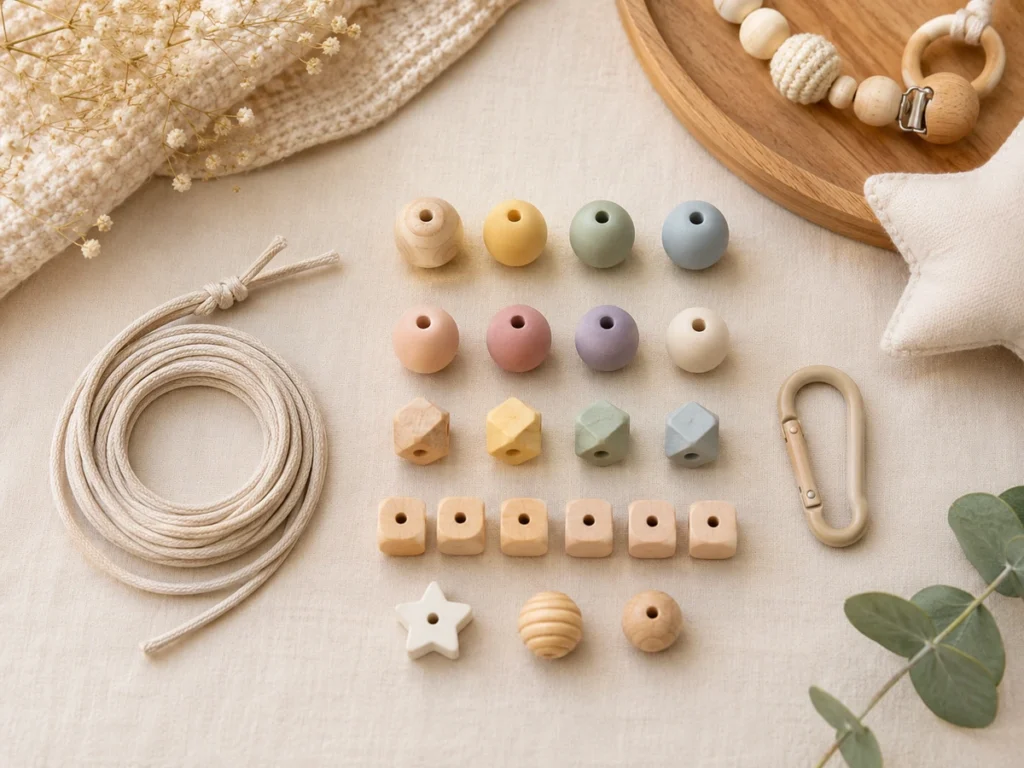
Step 1: Cut about 15 cm of cord. Tie one end securely to the carabiner or keyring. Double knot, hidden inside.
Step 2: Thread wooden beads and letter beads alternately, depending on your planned layout. Classic: two beads — name — two beads — motif bead — finish.
Step 3: Pay attention to the reading direction: the charm hangs at the bottom of the bottle, so it’s read from the top.
Step 4: Close with the safety bead. Double knot, hidden inside. Cut the cord and seal briefly.
Step 5: Attach the charm to the bottle neck or the carrying strap. If the bottle has no handle, you can attach the charm with the carabiner directly to the bottle ring.
4. Variations and theme ideas
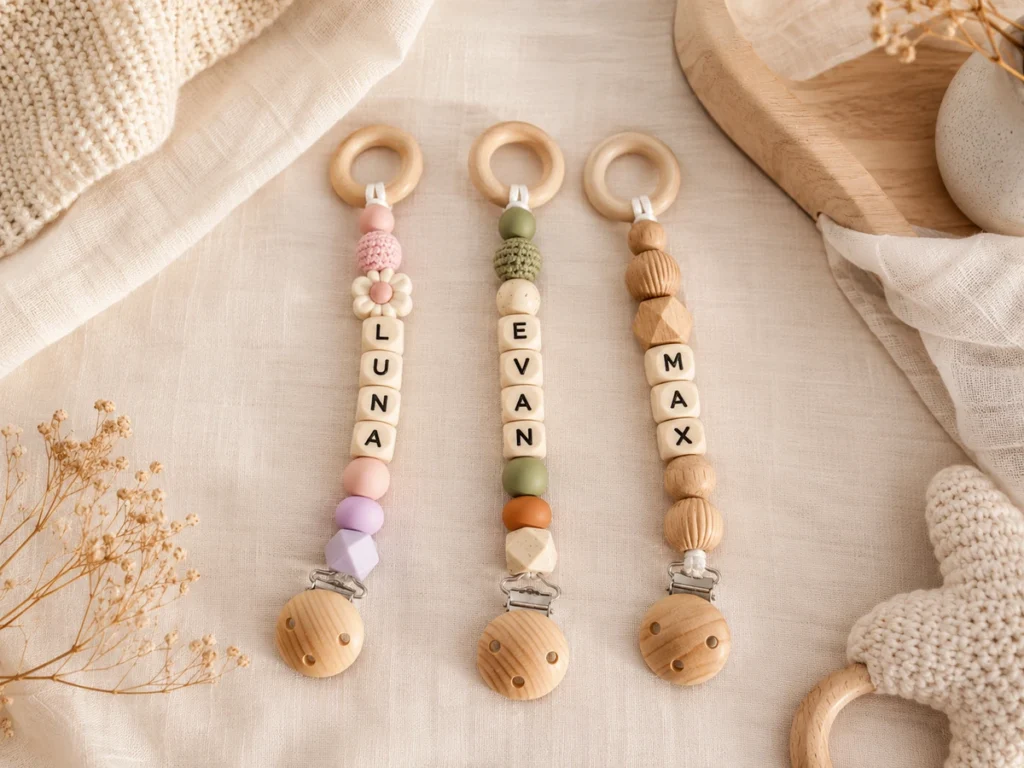
The basic charm is already lovely — but you can vary it:
Animal version: Instead of a motif bead, a small crocheted animal. Rabbit, mouse, fox — works with almost any child.
Bell version: A small bell at the end. It jingles softly when you carry it — babies love that.
Sibling version: If there are twins or siblings, make two charms in the same style, but with different names and a contrasting accent colour each. That way they’re recognisable as a set, but individual.
Seasonal version: Pastel spring, bright summer colours, earthy autumn tones, pale winter pastels. Change the charms with the seasons. Over the top? Maybe. Cute? Absolutely.
Travel version: With a small anchor, star or wave as the motif bead for families who travel a lot with their baby.
5. Safety and care
Baby bottles are washed daily, often in hot water. The charm should therefore be easy to remove — otherwise it ends up in soapy water, which isn’t good for the wood. Ideally, take it off before washing each time.
If the charm stays on: rinse it separately with lukewarm water and a drop of washing-up liquid. Let it dry before putting it back on the bottle.
Make sure the cord is tear-resistant. If it breaks and beads come loose, they could end up inside the bottle — not a good scenario. Check the charm regularly for wear and replace the cord if it starts to fray.
All materials should be certified to DIN EN 71-3 standard. This is especially important when the charm hangs on a baby item that’s right next to the child’s mouth every day.
FAQ
Can the charm go in the dishwasher?
No, never. Hot water plus dishwasher tablets destroy the wood quickly. Remove it before each wash.
How do I attach the charm to the bottle neck?
Easiest with a small carabiner through the bottle ring. Or as a cord loop looped straight around the bottle neck. Both options are quick to take off and put back on.
What’s the right bead size?
10 mm to 12 mm is the best choice — big enough so the name is easy to read, and small enough so the charm doesn’t look clunky.
Is the charm really necessary or just decoration?
In nursery and toddler group it’s practically essential — it solves the bottle mix-up problem in two seconds. At home it’s more of a decoration, but a very lovely one.
How long does a charm like this last in everyday use?
With good care and tear-resistant cord, one to two years, sometimes longer. That’s usually the entire bottle-feeding phase of a child’s life.
Ready to make your first charm?
At Kiki-Ena you’ll find everything you can turn into a finished charm in ten minutes — letter beads, motif beads, sturdy cords and small carabiners.