
1. What is a ‘number concept’ exactly?
A number concept is the understanding that a number represents a fixed quantity — regardless of how the items look, how they’re arranged, or how large they are. Three apples are three. Three stones are also three. Three enormous stones and three tiny peas are both three. This quality, known as invariance, is far from automatic for young children’s minds.
Reciting number words — “one, two, three, four” — has nothing to do with this initially. It’s pure rote memorisation, like learning a poem. Real mathematical understanding only begins when the child can connect those number words to actual quantities.
2. The Five Stages of Quantity Development
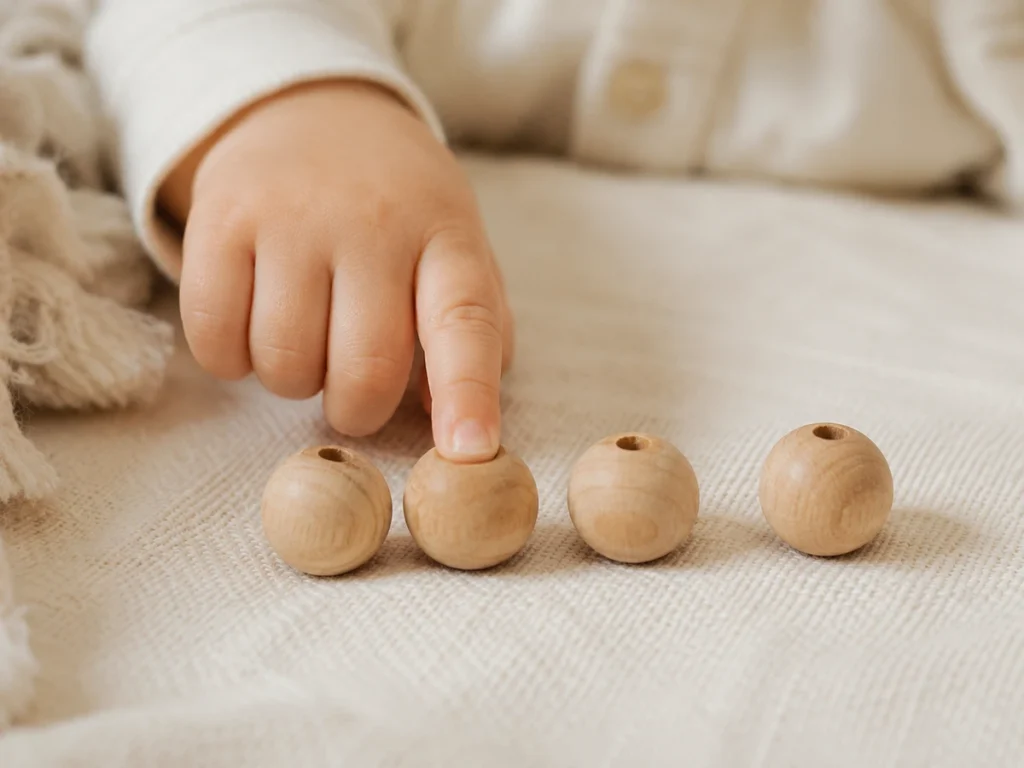
These developmental stages are well documented in research. The age ranges below are rules of thumb:
| Stage | Age (approx.) | What the Child Can Do |
|---|---|---|
| 1. Quantity Awareness | 0–2 years | Recognises “lots” and “a little” intuitively |
| 2. Counting Rhyme | 2–3 years | Recites number words in the correct order — without connecting them to quantity |
| 3. Counting-On | 3–4 years | Assigns one number word to each object (one-to-one correspondence) |
| 4. Cardinality Principle | 4–5 years | Understands: the last number named tells you the total amount |
| 5. Quantity Comparison | 5–6 years | Compares quantities, adds small numbers, understands “more than” |
3. Which Materials Really Work
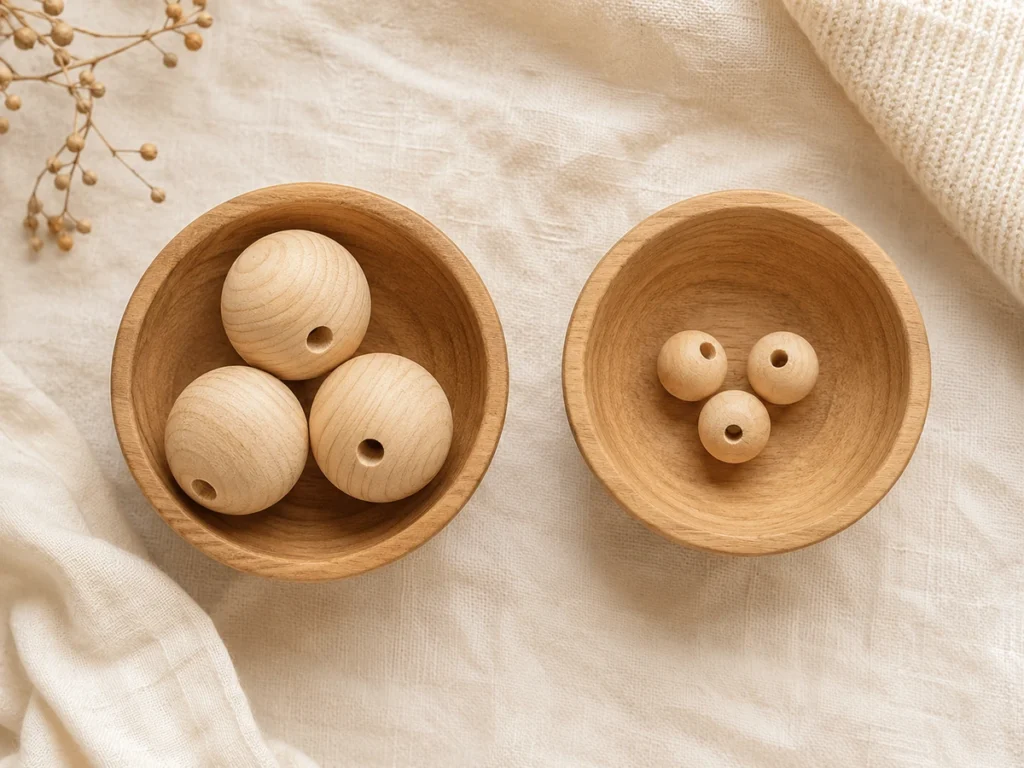
The Classics — and Why They Work
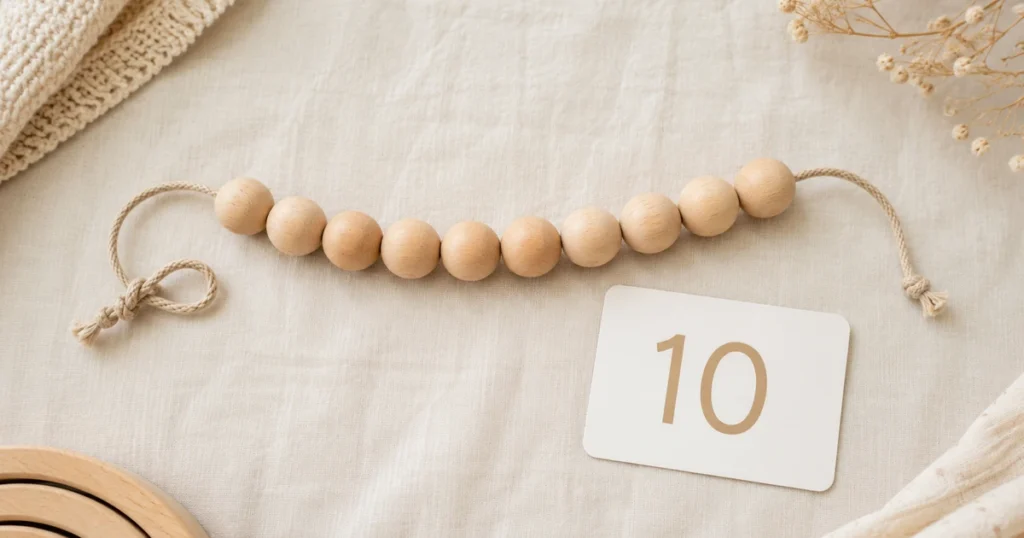
- Wooden beads in a line: Arguably the most powerful material. A line of beads makes a quantity visible instantly. Threaded onto a ten-bar, it becomes a measuring standard.
- Counting chains: Five red, five blue beads — your hand feels exactly where the change happens. Brilliant for understanding the number 10.
- Spindle box: Compartments numbered 0–9, with wooden sticks to place inside. A Montessori classic, perfect for one-to-one correspondence practice.
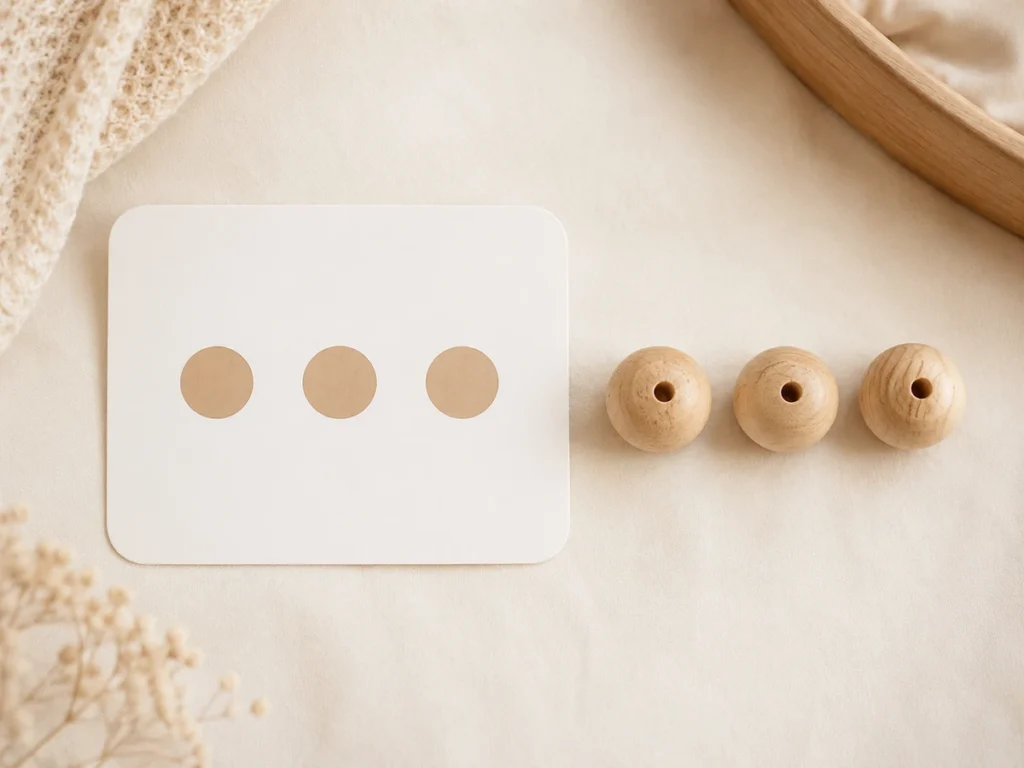
- Quantity cards with dots: The card shows two, three, or five dots — the child matches wooden beads to the number.
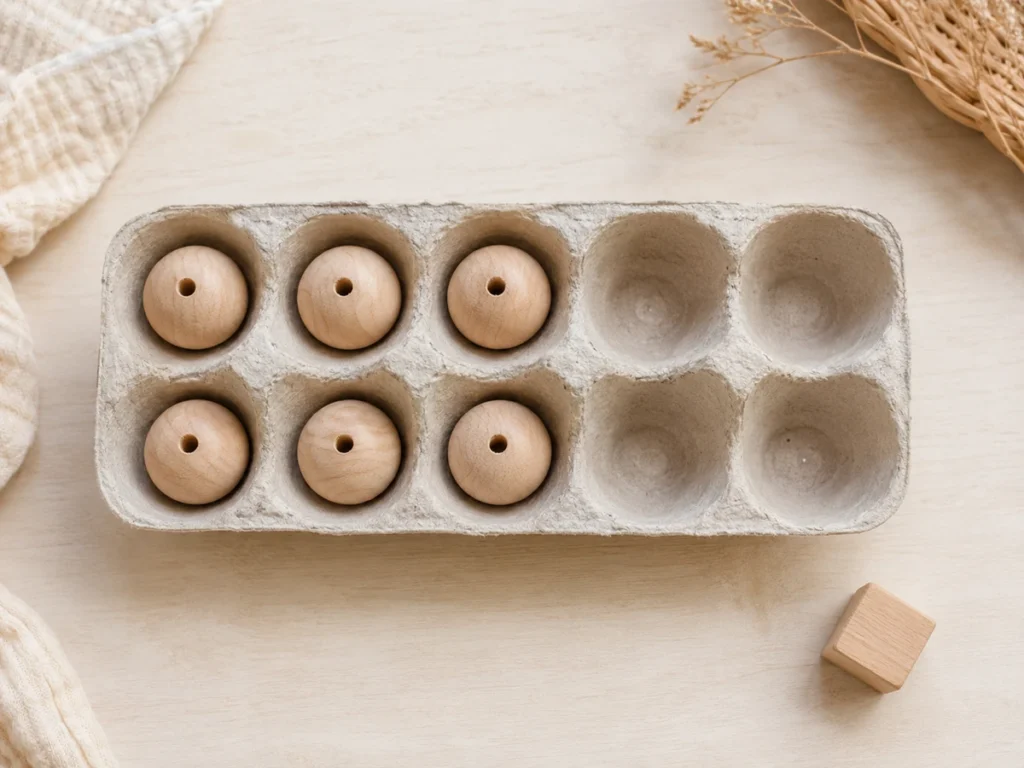
- Egg box + wooden beads: Ten cups, one bead per cup. The concepts of “full” and “empty” emerge naturally.
What Doesn’t Work (or Works Poorly)
- Apps with animated numbers — children learn the rhyme, not the concept.
- Number books to memorise — passive, no real understanding.
- Clock faces on the wall — too complex for the early stages.
4. Ten Activities — Ready to Use Today
- Setting the table: Three children at the table — three plates. One-to-one correspondence in everyday life.
- Counting the stairs: Count aloud on each step — movement combined with counting.
- Laying out bead lines: A card showing the number 4 — lay out four beads in a line.
- Egg box game: Roll a dice, place that many wooden beads into the egg box.
- Quantity Memory: Cards with dots and cards with numerals — find matching pairs.
- Finger songs: “Five Little Ducks” — one fewer finger with each verse.
- Sharing out beads: Ten beads, three bowls — divide fairly. First experience of sharing/division.
- Birthday candle counting: Four candles for four years. Real, personal, emotionally anchored.
- Guessing quantities: Jar with 12 wooden beads — how many inside? Guess first, then count to check.
- Stringing numbers: One bead for 1, two beads plus a knot for 2, three beads plus a knot for 3 — numbers become a chain.
5. Common Pitfalls
- Counting too high too soon. A child who can recite up to 30 often doesn’t yet understand the number 5. Go deeper, not higher.
- Confusing number words with quantities. Have the child actually count what they’re counting — finger on each object.
- Starting with number symbols. First comes quantity, then the word, finally the symbol “3”. In that order.
- Applying pressure. Early number learning must stay fun. Frustration at this stage causes lasting harm.
- Sitting down only. Count the stairs, collect stones, share out biscuits — maths is everywhere. Use daily life.
FAQ
When do I start with number development?
Playfully from the second year onwards — count along as you climb stairs, say “one shoe, two shoes” while dressing. Structured work with materials from around age 3.
Is nursery teaching enough?
Most nurseries intensify maths learning in the two years before school. Children who are already familiar with beads and quantities at home benefit greatly — but early learning isn’t about getting ahead in reception.
When do I need ‘proper’ maths materials?
Wooden beads, egg boxes and dice are plenty for the early years. Specialist learning materials like spindle boxes or golden beads are worth it from pre-school age onwards.
For Nurseries & Childminders: Quantity sets with wooden beads, counting chains and quantity cards in nursery sizes — bulk discount from 10 units, invoice payment available. Request our educational settings range.