
1. What “saliva-resistant” means in law
The term “saliva-resistant” doesn’t come from marketing—it comes from DIN EN 71-3, the European standard for toy safety in relation to chemical properties. Saliva-resistant literally means: when in contact with artificial saliva for two hours at 37°C, no colour pigments or other substances may migrate into the saliva in quantities that exceed the defined limit values.
The standard tests 19 elements, including lead, cadmium, chromium (VI), mercury, arsenic and barium. Each has a maximum permissible value in milligrams per kilogram of material. A saliva-resistant wood finish doesn’t need to be “natural” or “organic”—it just needs to ensure that the colour pigments are firmly bound in the coating and don’t transfer into saliva.
2. Three coating systems you’ll find on wooden beads

In practice, manufacturers use three different coating systems. All three can be saliva-resistant—but they differ in appearance, feel and sustainability:
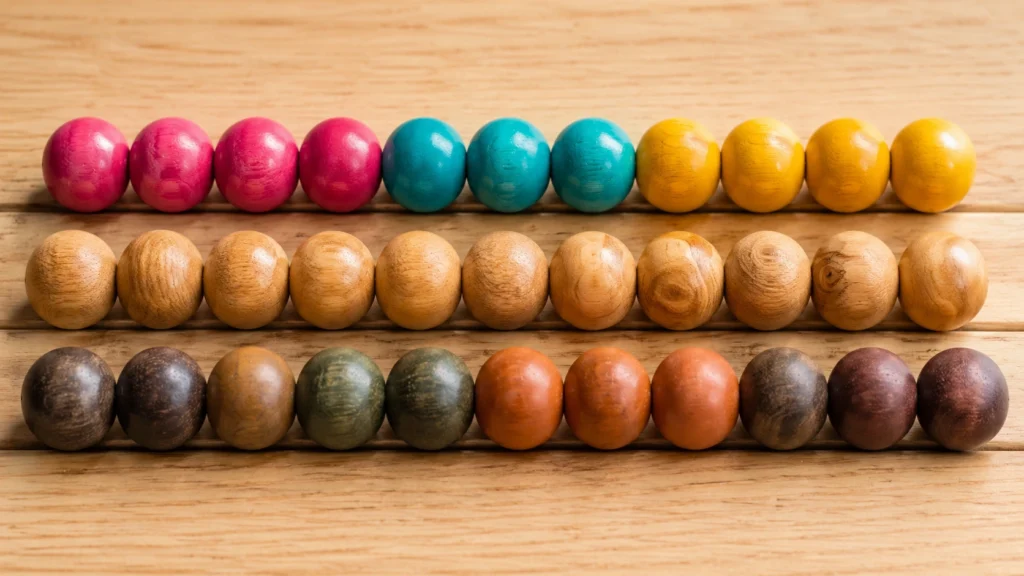
- Food-safe water-based lacquer: The standard for German branded manufacturers. Pigments are bound in a water-soluble acrylate dispersion that cross-links after application to form a water-resistant, flexible coating. Advantage: vibrant colours, long-lasting, excellent saliva-resistance. Disadvantage: synthetic origin.
- Wood stain plus beeswax: The wood is coloured throughout with a water-based wood stain. The colour sits deep in the wood fibres. The bead is then sealed with pure beeswax. Advantage: natural feel, wood grain remains visible, fully compostable. Disadvantage: less vibrant colours, the wax layer needs refreshing after roughly a year of intensive use.
- Food-grade mineral pigments in hard oil: Mineral pigments (iron oxide for red, titanium dioxide for white) are dispersed in a natural hard oil made from linseed oil. Advantage: maximum natural appeal and very good saliva-resistance. Disadvantage: considerably more expensive, limited colour palette.
If you spot a bead in our wooden beads categories in vibrant pink, neon green or bright turquoise—that’s system 1 (food-safe lacquer). Natural wood look with visible grain typically comes from system 2 (stain plus beeswax). When in doubt, ask the manufacturer for the technical data sheet.
3. How the saliva-resistance test works in the lab
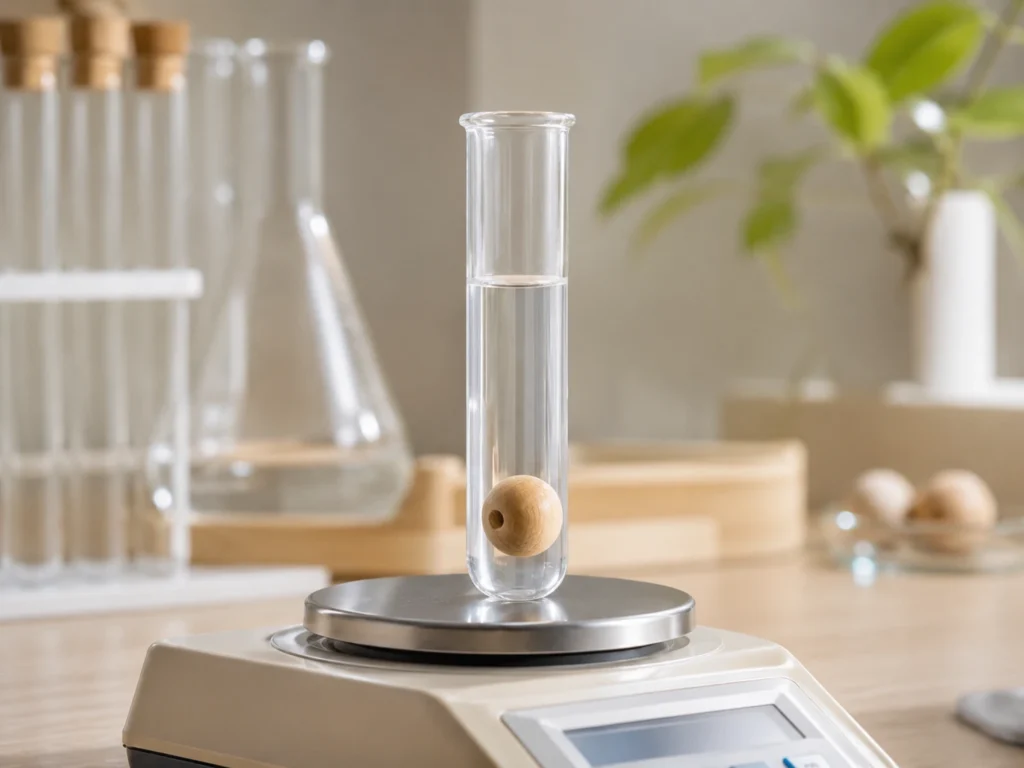
The test is surprisingly aggressive. The bead is immersed in artificial saliva made from deionised water, sodium chloride, potassium chloride and lactic acid. This mixture simulates the chemical composition of real saliva, including its slightly acidic pH of roughly 6.5. The sample is immersed for two hours at body temperature (37°C) and continuously stirred.
The saliva liquid is then analysed for the 19 elements using mass spectrometry. If all values are below the limit values, the bead is “saliva-resistant” according to the standard. This test is repeated for every new colour batch at reputable manufacturers—not just once at product launch.
4. “Saliva-resistant” doesn’t mean “edible” and doesn’t mean “safe if swallowed”
This is probably the most common misunderstanding. A saliva-resistant wooden bead doesn’t release harmful substances into saliva, but that doesn’t make it food. If swallowed, it remains a foreign body that can cause choking or intestinal injury.
That’s exactly why baby toy safety always has two layers: saliva-resistance according to EN 71-3 (chemical) plus mechanical safety according to EN 71-1 (small parts test, tensile strength). A 12mm wooden bead that is saliva-resistant won’t fit into the small parts cylinder and therefore cannot be swallowed—that’s the actual protective combination.
5. How to spot genuine quality in everyday use
When browsing the online shop, the check is simple: look for four things. First, a specific reference to DIN EN 71-3 (not just “tested”). Second, information about the coating system (food-safe lacquer, beeswax, hard oil). Third, the country of manufacture—with German manufacturers, the strictest interpretation of EU toy regulations applies automatically. Fourth, the price: high-quality saliva-resistant wooden beads cost between €0.30 and €1.50 per piece. If someone offers a bulk pack of 100 beads for €4.99, they simply can’t cover the testing costs.
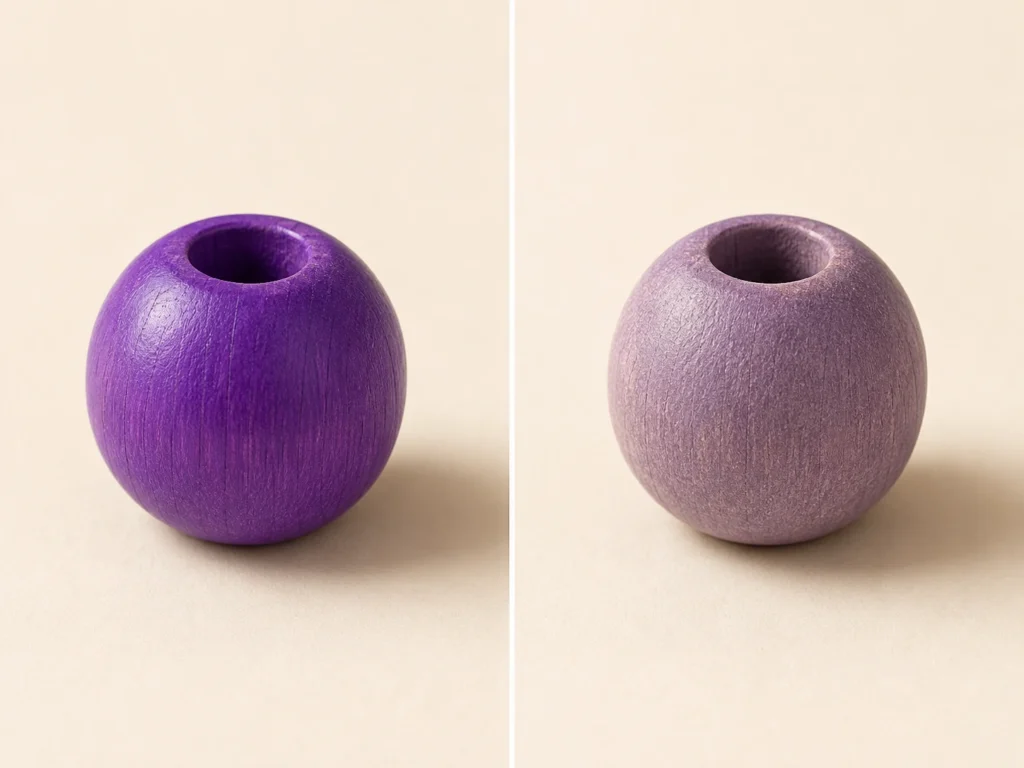
In everyday use, you can tell a good colour seal holds up by whether the bead keeps its colour after intensive use (several weeks of saliva contact, sunlight, cleaning). If a bead noticeably fades, that’s a sign that pigments are migrating—exactly what the standard was designed to prevent.
FAQ — Saliva-resistant wood finishes
Are all wooden beads automatically saliva-resistant?
No. Untreated natural wood beads without coating are only saliva-resistant if the wood used is free of pesticides and bleach. Lacquered beads must be tested according to DIN EN 71-3 to carry the label.
What happens if my child sucks on a saliva-resistant bead for a long time?
That’s exactly what the test is designed for. Even after several hours of saliva contact, the colour layer remains intact and no harmful amounts of pigment transfer into the saliva.
Can I clean saliva-resistant beads in the dishwasher?
We advise against it. High temperatures (over 60°C) and aggressive cleaners can damage the seal over time. Better: lukewarm water, mild soap, air dry.
What’s the difference between “saliva-resistant” and “perspiration-resistant”?
Both tests work similarly, but the test solution is slightly different (perspiration contains more lactic acid and ammonia). High-quality beads are usually both—DIN EN 71-3 tests both saliva and perspiration in the same procedure.
Does beeswax last as a seal?
Under normal use, about 12 to 24 months. With intensive saliva contact (constant sucking), the wax layer can thin out sooner—but it’s easy to refresh with a little beeswax and a soft cloth. Find out more in our article on beeswax sealing.
Looking for safe wooden beads? In our wooden beads categories you’ll find only beads tested according to DIN EN 71-3 and made in Germany. Also check out our comparison of wood vs. silicone.